English
 Polish
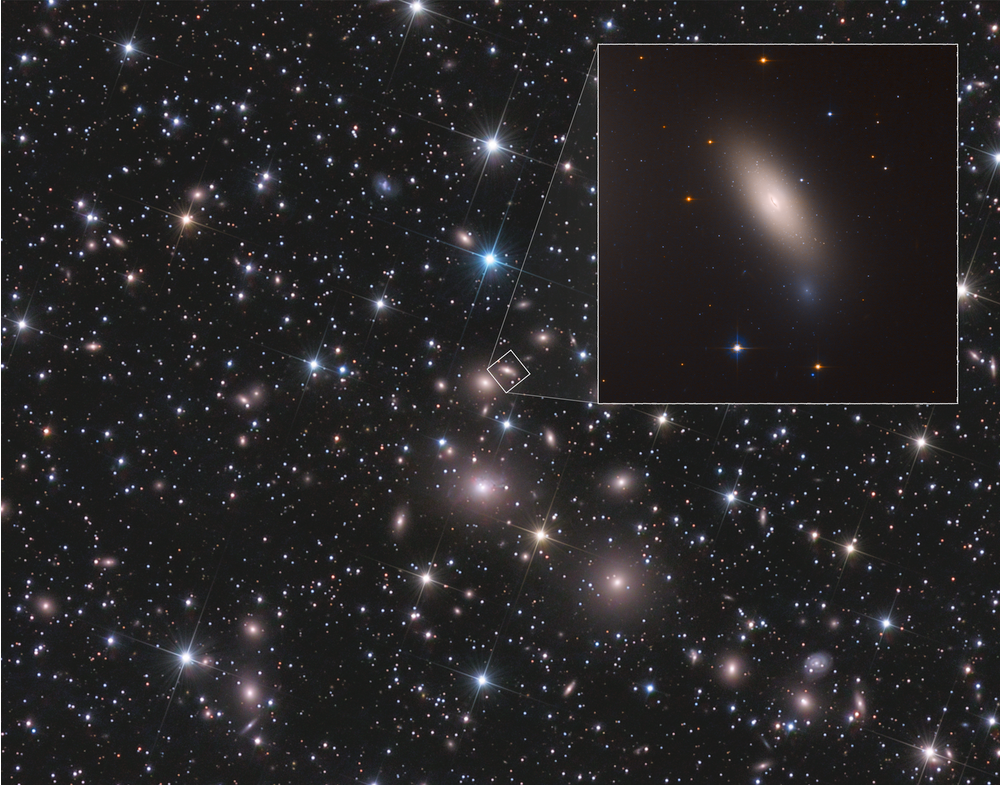
Cosmic Chronometers: What relic galaxies tell us about the expansion of the Universe
13-10-2026
According to currently accepted cosmological models, our Universe is constantly expanding, and the rate of this expansion continues to increase. However, measuring this rate poses a major challenge for scientists, which is why new methods are being sought, such as the study of so-called compact relic galaxies. In a recently published paper, a team of researchers from the Astrophysics Division of the National Centre for Nuclear Research has shown that these extraordinary objects may allow for a more accurate determination of the rate at which the Universe is expanding.
Recent decades have seen rapid advancements in many fields of science, including cosmology. The vast amount of data provided by experiments and observations of the sky has made it possible to develop models aimed at describing as accurately as possible the laws that govern our Universe. One of the leading models is ΛCDM, which combines the cosmological constant Λ, responsible for the accelerating expansion, with cold dark matter (CDM), which interacts gravitationally with baryonic matter and accounts for the large-scale effects we observe.
However, modern models still contain elements that have not yet been clearly determined. These include, for example, the Hubble constant. It is a value that describes the rate at which galaxies are moving away from one another as a function of the age of the Universe. The value of the Hubble constant has been calculated by many research teams using various methods, including measurements of objects with low redshifts (Cepheids, Type 1a supernovae), and the cosmic microwave background (CMB). However, the results obtained differ by 4σ, which is why new, independent methods are being sought that will account for additional effects and reduce the uncertainties in the results.
Among these methods is the so-called cosmic chronometer (CC), which is based on measuring the age difference between passive galaxies, that is, those in which star formation has ceased. Until now, massive elliptical galaxies, known as early-type galaxies, have been studied for this purpose. However, their evolution often involves collisions with other galaxies, which can introduce additional populations of young stars or trigger new star-forming processes, thereby limiting their usefulness in this method. A team of researchers from the Astrophysics Division of the National Centre for Nuclear Research (NCBJ) has found an alternative approach – they utilized a rare subcategory of galaxies known as ultra-compact massive galaxies. These objects originate from so-called “red nuggets,” in which an early star-forming phase was followed by passive evolution, without significant collisions with other galaxies. They may therefore constitute a homogeneous population free from “contamination” by additional phenomena.
In their work, researchers from NCBJ used the largest currently available set of ultra-compact massive galaxies from the E-INSPIRE survey. To identify candidates from this set that could serve as cosmic clocks, the astrophysicists had to determine their "degree of relicness,” which describes how much a given galaxy has changed over the course of its existence. “To obtain a homogeneous yet statistically significant sample of galaxies, we imposed constraints on both their relicness and their redshift z, as well as their mass. Ultimately, we obtained a sample of nearly 200 relic galaxies, which allowed us to determine the value of the Hubble constant H(z)" – explains Krzysztof Lisiecki, a PhD student at the Astrophysics Division of the National Centre for Nuclear Research and the first author of the newly published article.
For the median redshift of the studied galaxy population, the team obtained a value for the Hubble constant H(z=0.15) = 85 ± 51.5 [stat] +10.2 −8.9 [sys] km s⁻¹ Mpc⁻¹. This result is consistent with other values obtained using the CC method, as well as with the predictions of the ΛCDM model. Despite a relatively high relative uncertainty (62%), it is comparable to other CC analyses. However, new studies show that analyzing relic galaxies allows for a significant reduction in systematic uncertainties, which typically arise from galaxy modeling effects. The majority of the statistical uncertainty will be reduced in the future thanks to new sky surveys, such as Euclid and the Vera C. Rubin Observatory. The vast amounts of precise data will make analyses using relic galaxies as cosmic clocks a promising path for uncovering the history of the expansion of the Universe.
The full results of the study are available in the publication: K. Lisiecki, et al. CORN -- Chronometers of Relic Nature I: The first estimate of the expansion rate of the Universe using compact relic galaxies, Astronomy&Astrophysics, 714 (2026) A268, DOI: https://doi.org/10.1051/0004-6361/202660942.