English
 Polish
NCBJ educates the public about radiological events.
12-11-2026
The National Centre for Nuclear Research (NCBJ) educates and informs the public on how to prepare for emergencies involving radiological events.
When preparing for potential emergencies, we usually think about hazards caused by extreme weather events, such as floods or fires. We rarely consider incidents involving chemical, biological or radiological contamination. It is important to be aware of these risks and know how to respond should such an event occur.
NCBJ safeguarding radiological safety
As the operator of Poland's only operational nuclear reactor, the MARIA research reactor, the National Centre for Nuclear Research continuously monitors radiological hazards and ensures ongoing supervision of the nuclear facility. Protecting the safety of employees and nearby residents is one of the key responsibilities of NCBJ experts specialising in dosimetric measurements. Dosimetry is a branch of nuclear physics concerned with measuring doses of ionising radiation and studying their effects on living organisms.
In the natural environment, sources of ionising radiation include cosmic radiation and radiation emitted by naturally occurring radioactive elements on Earth (e.g. radon). The annual level of this natural radiation (known as background radiation) is approximately 2.5 mSv (millisieverts). For comparison, a spinal X-ray delivers a dose of approximately 1 mSv, a whole-body CT scan approximately 20 mSv, while a flight from Poland to the United States results in an exposure of approximately 50–80 mSv. A dose that causes acute radiation sickness is approximately 1,000 mSv.
NCBJ's Dosimetry Measurement Laboratory provides 24-hour dosimetric monitoring and remains on constant standby in the event of a radiological emergency. Laboratory staff regularly monitor the area surrounding the MARIA research reactor and analyse soil, water and air samples, enabling a comprehensive radiological assessment of the environment. NCBJ experts develop innovative tools that enable precise, real-time measurements of ionising radiation, allowing an immediate response whenever measurement levels change, even slightly. All NCBJ activities in this area are governed by precise and stringent regulations.
Alerts for residents
The Government Centre for Security (RCB), acting on the instructions of the Ministry of National Defence and the Ministry of the Interior and Administration, has published a Safety Guide. It provides information on how every citizen should prepare for various types of emergencies, including incidents involving radiological and nuclear contamination.
In the event of a radiological emergency, it is ESSENTIAL to:
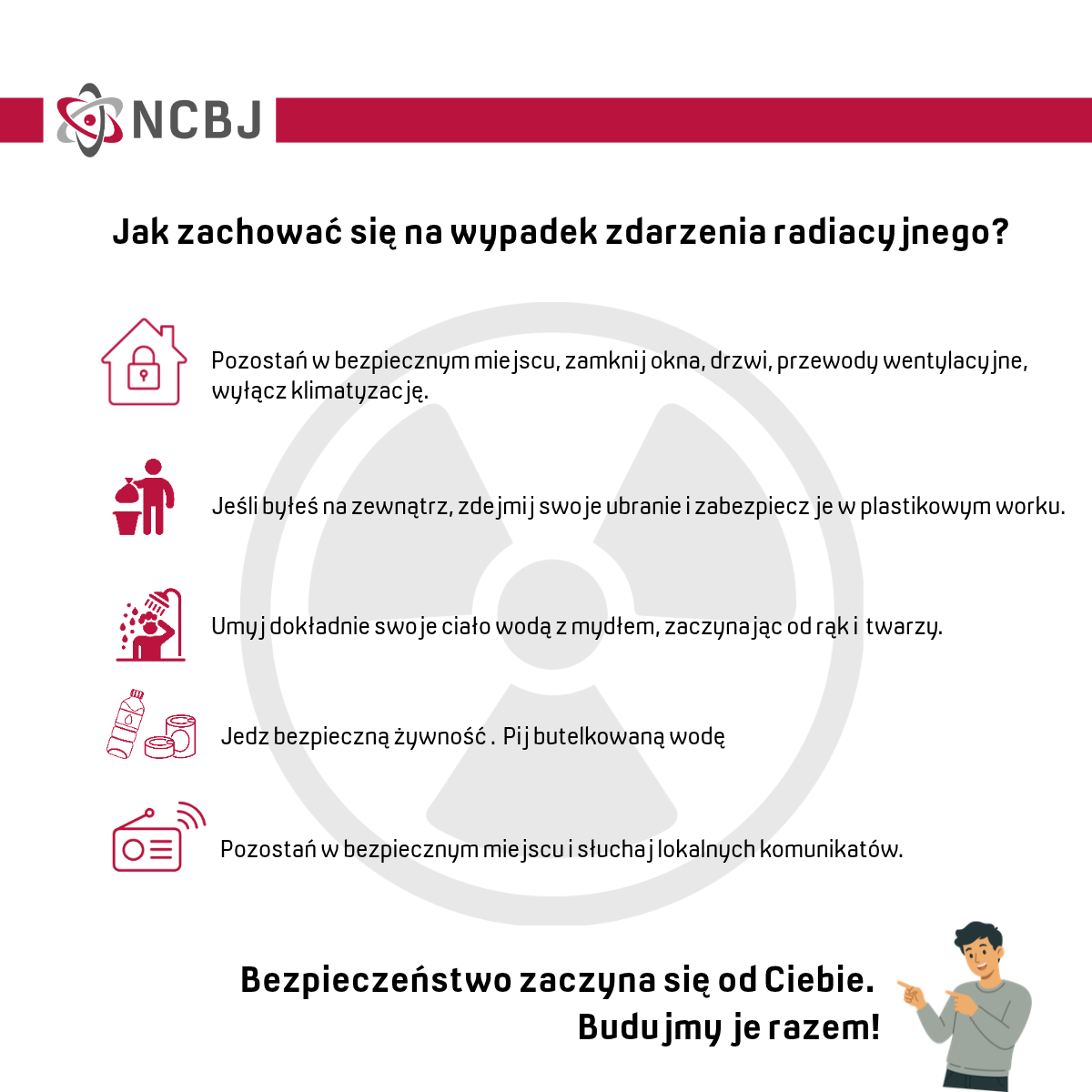
- Take shelter in buildings where windows, doors and ventilation ducts can be properly sealed. Turn off the air conditioning.
- If you have been outdoors, remove your clothing and seal it in a plastic bag. Then wash your entire body thoroughly with soap and water.
- Do not eat or drink any products (including water) that may have been exposed to contamination.
- Remain in a safe place until the alert has been officially lifted.
Remember to follow local announcements published by trusted sources, such as the National Centre for Nuclear Research, the Provincial Office or emergency services.
Radiation levels at the site of contamination decrease significantly within just a few days.
Training new professionals to ensure safety
Being prepared for emergencies is every citizen's responsibility. To ensure radiological safety, the National Centre for Nuclear Research continuously trains its employees and modernises the equipment used to monitor ionising radiation. NCBJ also provides training courses for radiation protection officers and educates experts responsible for the safety of nuclear infrastructure. These professionals may find employment at Poland's first nuclear power plant, which is currently under development. Our training programmes are supervised by the National Atomic Energy Agency (PAA).
Advance Information for the Public on the Possibility of a Radiological Emergency
| File | Format | Download |
|---|---|---|
| Advance Information for the Public on the Possibility of a Radiological Emergency | Download PDF | |
| Radiological Emergency | PNG | Download image |