English
 Polish
New Polish neutron facility in the MARIA reactor for research into modern cancer therapy
05-03-2026
The National Centre for Nuclear Research is launching new infrastructure enabling irradiation with a thermal neutron beam in the MARIA research reactor. This is an important step towards the development of an innovative method of cancer treatment – boron neutron capture therapy, which allows cancer cells to be destroyed more precisely while protecting healthy tissues.
The project was presented in Applied Radiation and Isotopes, Volume 222, 2025, 111876, ISSN 0969-8043, https://doi.org/10.1016/j.apradiso.2025.111876; (https://www.sciencedirect.com/science/article/pii/S0969804325002210)
New opportunities for medicine and science
The neutron irradiation facility launched as part of the H2 Neutron Laboratory will enable research into the use of neutrons in medicine, materials science and biology. However, the most important goal is the development of boron neutron capture therapy (BNCT), considered one of the most promising methods for treating difficult and resistant cancers.
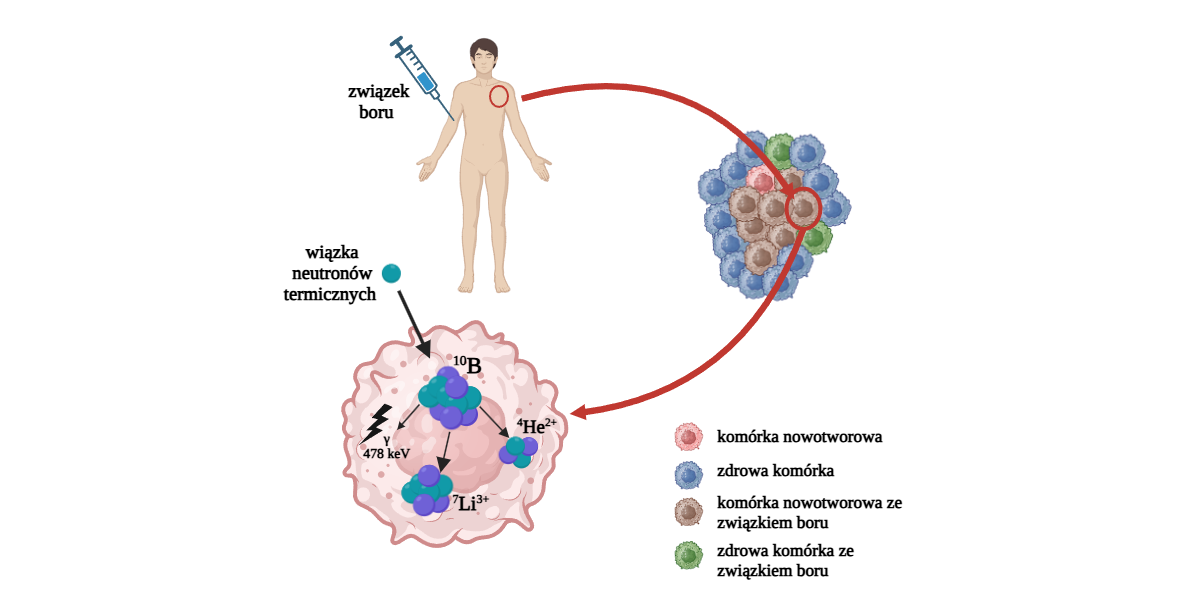
In this therapy, the patient receives a boron-containing compound that accumulates in tumour cells. A neutron beam is then directed at the affected area. As a result of the neutron capture reaction by the stable boron-10 nucleus, followed by the decay of the resulting nucleus into a high-energy alpha particle and a lithium-7 nucleus, the cancer cells are destroyed with minimal damage to the surrounding tissue.
Precise beam and safety
The installation has been designed to enable the production of neutron beams with different energy ranges and to ensure safe access to the research station while the reactor is in operation. The device is currently undergoing commissioning and testing prior to the actual research experiments.
The new facility will also be used for research on the effects of radiation on materials, biological testing and the development of radiation dose measurement methods.
A step towards the therapy of the future
– The launch of this installation paves the way for advanced research on BNCT therapy in Poland. This is a real opportunity to develop more effective methods of cancer treatment and strengthen the national research base in the field of medical physics – says project manager dr inż. Michał Gryziński. – The H2 team has just completed the second stage of neutron beam extraction, i.e. the installation of a revolver beam shutter. The extracted thermal neutron beam will enable radiobiological and preclinical research into brain cancer therapy. This therapy allows for the treatment of previously incurable cancers. The research conducted at the facility will enable the development of the therapy worldwide and its introduction in Poland. It was a difficult technological undertaking, as the work took place at the reactor core level, in close proximity to it. We also hope to complete the third and final stage, which will involve increasing the beam intensity by installing a neutron converter in the reactor core – he adds.
The new infrastructure at the MARIA reactor strengthens Poland's position in international research on the use of neutrons in medicine and may in future translate into access for patients to more precise cancer treatments.
Authors
The team of authors consists primarily of researchers from the National Centre for Nuclear Research in Otwock: Edyta Michaś-Majewska, Katarzyna Tymińska, Maciej Maciak, Michał Kuć, Maciej Wiliński, Jarosław Grzyb, Aleksandr Bancer, Elżbieta Jaworska, Monika Kopińska, Martyna Celejowska, Martyna Araszkiewicz, Agnieszka Dróżdż, Szymon Domański, Marcin Pietrzak, Grzegorz Wojtania, Gabriel Raj, Piotr Mazerewicz, Adam Małkiewicz, Łukasz Murawski, Antoni Zawadka, Andrzej Bigos, Piotr Wiszniewski, Aleksandra Niepokólczycka-Fenik, Janusz Wilczek, Krystian Grodzicki, Natalia Knake, Monika Wielgosz, Gaweł Madejowski, Rafał Prokopowicz, Agnieszka Celińska, Ireneusz Owsianko, Jan Lechniak and Michał A. Gryziński. Representatives of other research centres are also involved in the work: Warsaw University of Technology – Institute of Microelectronics and Optoelectronics (Krystian Król), Łukasiewicz Research Network – Institute of Telecommunications and Radio Technology in Warsaw (Łukasz Krzemiński) and Warsaw University of Life Sciences (Kamila Maliszewska-Olejniczak).