English
 Polish
Quantum entanglement verifies the validity of the Standard Model
09-09-2026
An article by the BESIII team has been published in the prestigious journal *Nature*, to which researchers from the Department of High-Energy Physics at the National Centre for Nuclear Research (NCBJ) made a key contribution. This latest paper presents pioneering research into hyperon decay using polarisation and quantum entanglement, which opens up a new avenue for testing the validity of the Standard Model of elementary particles and the search for new physics.
The Standard Model is one of the fundamental theories of modern physics. It describes the elementary particles from which matter is composed, as well as three of the four interactions (electromagnetic, strong and weak) that can occur between them. However, there are unknowns within this model which suggest that, at the scale of elementary particles, phenomena occur that the model is unable to describe. Similarly, modern advanced research at the smallest scales indicates that there may be physics beyond the Standard Model. Therefore, scientists are striving to carry out increasingly precise measurements to test the validity of the Standard Model.
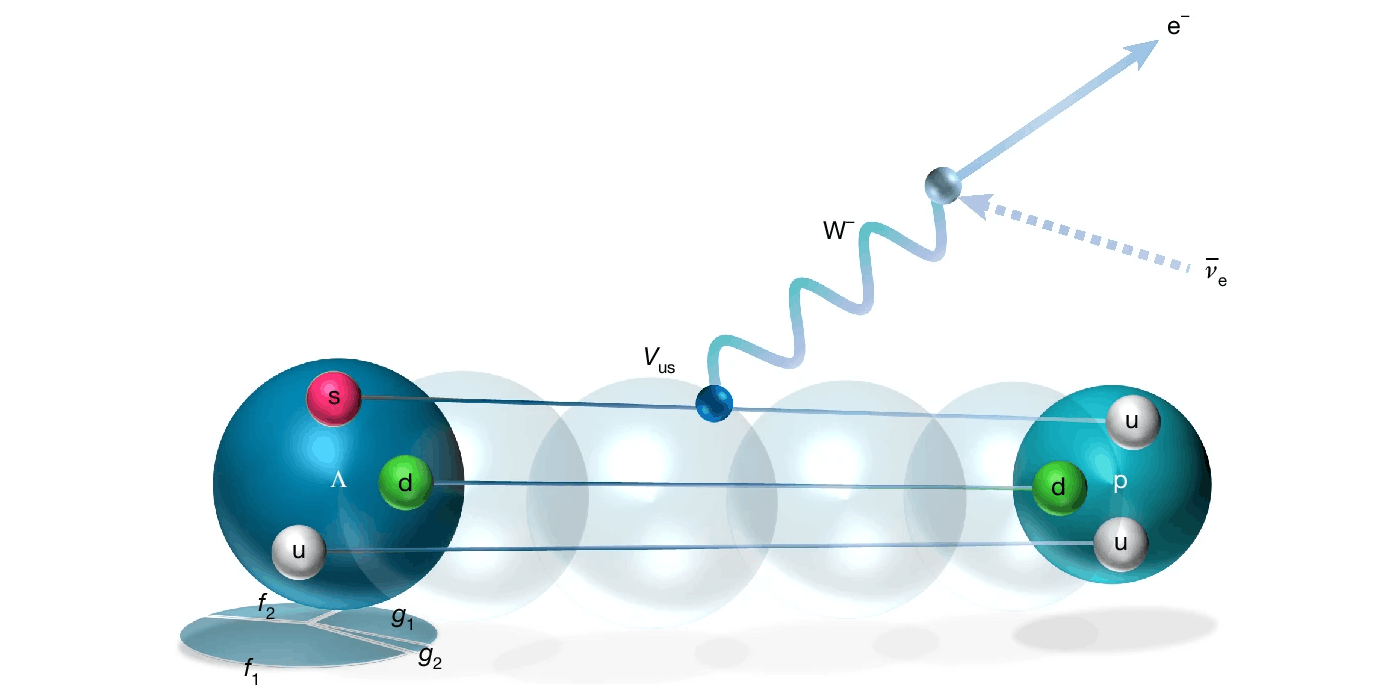
One of the elements enabling such tests is the Cabibbo–Kobayashi–askawa matrix (CKM matrix), which links the eigenstates of quarks associated with the weak interaction to their mass eigenstates. This matrix must be unitary, which imposes specific values on its coefficients and establishes relationships between them. Verifying the unitary nature of the CKM matrix involves determining the values of its elements, such as |Vus|, which describes the relationship between the up (u) and strange (s) quarks. Measurements of this value based on the decay of kaons (mesons containing a strange quark) introduce inaccuracies that may suggest the existence of new physics. An alternative method could be to study the decays of hyperons – baryons composed of strange quarks – but experiments to date have not been sufficiently precise.
Researchers from the BESIII collaboration have undertaken studies in this area, based on an innovative analytical method developed by Dr Varvara Batozska and Prof. Andrzej Kupść, PhD, from the National Centre for Nuclear Research. This method utilises quantum entanglement and the spin of baryons from the decay of the J/ψ resonance into a pair of lambda hyperons. This analysis, in which the NCBJ team was responsible for implementing this innovative method, enabled the precise determination of the parameters describing the structure of these hyperons.
Our research has, for the first time, enabled us to determine some of the parameters characterising the semilepton decay of the lambda hyperon. Thanks to this, after a hiatus of over 30 years, we were able to determine the values of |Vus| with high precision. This innovative method utilises additional information – previous studies did not take into account the polarisation or quantum entanglement of baryons. This method also allows for much greater sensitivity to individual events. “Compared with the Fermilab measurements, a 20-fold smaller data set enables us to achieve comparable precision in the parameter measurements,” explains Dr Varvara Batozskaya from the Department of High-Energy Physics at the National Centre for Nuclear Research (NCBJ).
This work forms the basis of a new research programme. The method presented can be used to describe other baryon decays, both at BESIII and at current and future particle and antiparticle colliders. Combined with developments in quantum chromodynamics, particularly lattice QCD, it will be possible to determine the values of the CKM matrix elements with a precision comparable to that obtained from kaon decays. This will provide a crucial and independent test of CKM unitarity, and thus of the Standard Model,” adds Prof. Andrzej Kupść from the National Centre for Nuclear Research (NCBJ).
The research results are available in the publication: The BESIII Collaboration, ‘Exploring baryon semileptonic decays through polarisation and entanglement’, *Nature* 657, 92–97 (2026).
https://doi.org/10.1038/s41586-026-10818-8
The lambda hyperon decay method and the BESIII team’s research are also mentioned in the article: ‘Antimatter “tag” used to detect elusive particle decay’, Nature 657, 42–44 (2026)
https://doi.org/10.1038/d41586-026-02123-1
Also in the article: Semileptonic decays of spin-entangled baryon-antibaryon pairs, Physical Review D, D 108, 016011
https://doi.org/10.1103/PhysRevD.108.016011
Illustration: Diagram showing the decay of a lambda hyperon into a proton, an electron and an electron antineutrino via a virtual W- boson.
Source: https://doi.org/10.1038/s41586-026-10818-8