English
 Polish
Coinage under the early Piasts: New isotopic studies point to a local source of silver
29-10-2026
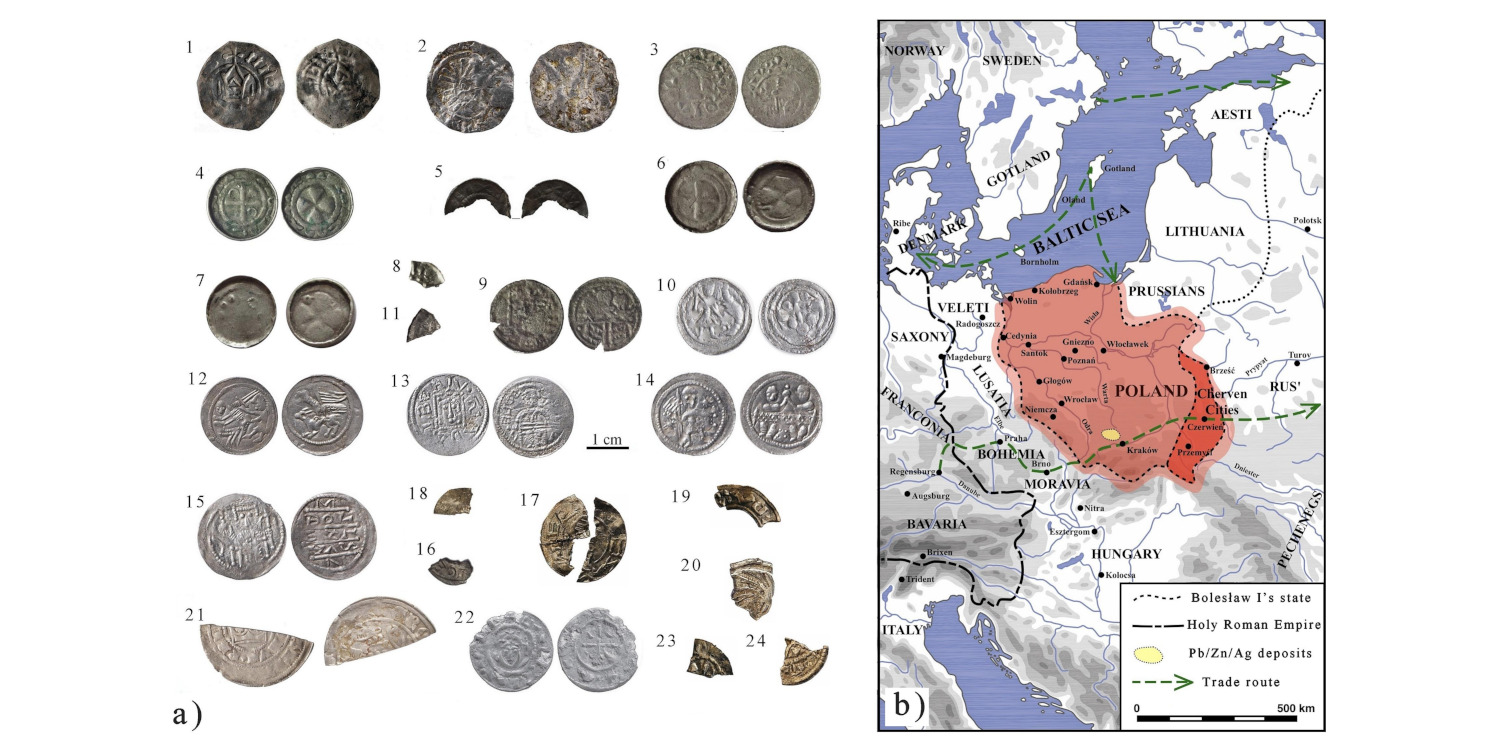
A team of researchers led by dr Ewelina Miśta-Jakubowska from the National Centre for Nuclear Research and the Institute of Archaeology at the Jagiellonian University analysed 24 coins dating from the 11th–12th centuries. Analysis of lead isotope ratios has shown that the silver in the earliest Piast coins has an isotopic signature consistent with lead-silver ores from the Upper Silesia-Krakow Upland.
The research was carried out in collaboration between the National Centre for Nuclear Research (Ewelina Miśta-Jakubowska, Aneta Gójska) and the Jagiellonian University, Adam Mickiewicz University in Poznań, the University of Silesia in Katowice, the Institute of Archaeology and Ethnology of the Polish Academy of Sciences, the University of Wrocław, the University of Warsaw, the Nicolaus Copernicus University in Toruń, the National Museum in Szczecin and the Vistula Academy of Finance and Business.
The issuance of local currency was a key element in the early formation of states. Contemporary research into medieval coins allows us to reconstruct not only the stages in the formation of individual European nations. Analyses of chemical and isotopic composition provide information on the circulation of precious metals, trade routes, and the politics and interactions between rulers at the time.
In the case of the early Piast dynasty, the origins of coinage are attributed to the reigns of Bolesław the Brave and Mieszko II (late 10th and early 11th centuries). However, the first coins were not minted on a large scale and were of a more representative nature. It was not until the end of the 11th century that the issue was increased and standardised, with the aim of replacing the foreign coins that dominated circulation, particularly the so-called cross deniers. These efforts continued into the 12th century, alongside a reform introducing compulsory currency exchange.
The increased production of coins raises the question of the origin of the precious metal from which they were made. Previous views had primarily attributed the source to silver from Arabic dirhams and denarii from Western Europe. However, new research also takes into account local deposits in the Upper Silesian-Kraków Upland, previously considered mainly as a source of lead.
The latest study, published in the Journal of Archaeological Science: Reports, presents analyses of 24 medieval coins, including 15 from the Piast period (from Bolesław the Brave to Bolesław the Curly), as well as Czech and Hungarian denars from a similar period. The researchers carried out chemical composition analyses and isotopic measurements aimed at identifying the regions from which the ore used to mint the coins originated. These were the first precise measurements of this kind on coins from early Poland, focusing primarily on detecting the presence of local ore deposits.
The research employed physical and chemical methods which made it possible to characterise the composition of the coins and investigate the origin of the silver used in their production. The elemental composition of all 24 coins was determined using X-ray microfluorescence (micro-XRF). This method uses X-rays to identify elements in the material under examination and enables analysis without the need for taking samples. The measurements made it possible to characterise the alloys in terms of their content of major and minor constituents, such as silver, copper, lead and zinc. The results obtained were semi-quantitative in nature and served primarily to assess the technological composition of the coins.
For a selected set of 11 coins, the composition of trace elements was additionally analysed using inductively coupled plasma mass spectrometry (ICP-MS). This method allows the concentrations of elements to be determined with high sensitivity, complementing the information obtained using micro-XRF. Of key importance for investigating the origin of the silver was the analysis of lead isotope ratios (LIA) using inductively coupled plasma mass spectrometry with a multi-collector analyser (MC-ICP-MS). As different deposits may exhibit varying lead isotope ratios, the results obtained can be compared with reference data for ore-bearing regions. By combining isotopic information with elemental composition, it was possible to distinguish features related to alloy production technology and metal mixing from signals relevant to the study of the coins’ origin. This made it possible to identify that some of the coins matched the isotopic signature of lead-silver ores from the Upper Silesian-Kraków Upland.
Most of the coins examined were characterised by a high silver content (90–97 %) with minor admixtures of copper and trace amounts of zinc, lead and other elements. The relationship between the lead and bismuth contents provides interesting insights into the technological processes of medieval coinage. A low bismuth content (below 200 ppm) may indicate the use of high-purity silver without admixtures from the remelting of other materials. A higher bismuth content may indicate repeated remelting, whilst a high concentration of lead combined with a moderate amount of bismuth may be the result of alloy modifications or the use of silver sourced from lead-rich deposits.
Analysis of the isotopic composition showed that the early Piast coins, particularly the first coins minted by Bolesław the Brave, were made from silver sourced from local deposits in the Upper Silesian-Kraków Upland. In contrast, later cross denarii were issued from an alloy combining various types of metal. In the case of Czech and Hungarian coins, a much broader origin of the silver is evident, with the material being a mixture from numerous sources, including the Upper Silesian-Kraków Upland.
Research provides the first evidence that, during the early Piast dynasty, local ore from deposits that had previously been regarded primarily as sources of lead was used in coin production. The isotopic composition characteristic of this region, found in later denarii, also indicates that the deposits were continuously mined. Over time, however, the coins also came to contain imported and remelted silver. Analyses of Czech and Hungarian coins also indicate that silver from the Silesian Upland entered circulation in Central Europe and was not confined to the territory of early Poland. This sheds new light on the territorial conflicts of that era, which may have had an additional resource-related basis.
The research demonstrates how a combination of analytical physics, chemistry and archaeology enables us to extract new information from artefacts which, for centuries, have been a source of knowledge about Europe’s economic and political history.
The research findings are available in the article: Ewelina Miśta-Jakubowska, Marzena Matla, Dariusz Rozmus, Adam Kędzierski, Bartłomiej Sz. Szmoniewski, Renata Czech-Błońska, Władysław Duczko, Aleksandra Pankiewicz, Aneta Gójska, Jakub Karasiński, Klaudia Tetfejer, Wojciech Chudziak, Anna B. Kowalska, Jacek Bojarski, Silvery dawn: the first use of local silver in early Piast coinage (11th–12th century Poland), Journal of Archaeological Science: Reports, Volume 76, Part A, 2026, 106113, ISSN 2352-409X, https://doi.org/10.1016/j.jasrep.2026.106113.