English
 Polish
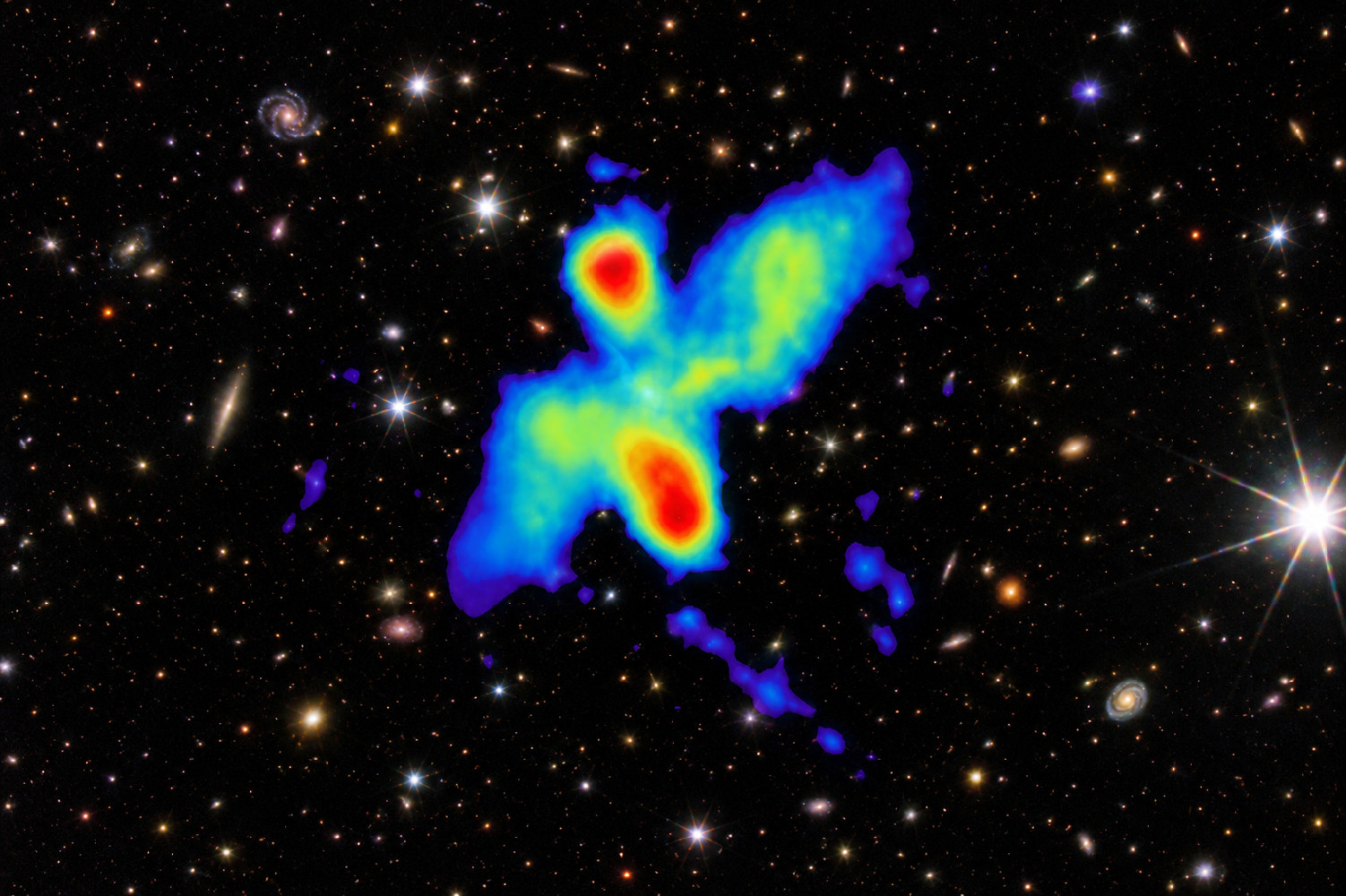
Are cosmic butterflies hiding the binary supermassive black holes?
22-07-2026
X-shaped radio galaxies (XRGs) are a rare class of active galaxies, whose origins are still uncertain. Scientists believe they might be linked to galaxy mergers, which makes them candidates to find black hole pairs that will produce gravitational waves in the future. Results of the study of almost 200 XRGs, led by Prajnadipt Ghosh, a doctoral student from the Astrophysics Division at NCBJ, have just been published in the Astrophysical Journal.
XRGs are characterized by their radio jets forming a distinctive X-shaped structure, rather than the more common double-lobed morphology. They have been studied for decades, but researchers are still uncertain as for their origin. One of the leading hypotheses suggests their link to galaxy mergers, where two supermassive black holes (SMBHs) form a bound pair, which causes the jet axis to rapidly reorient. When these SMBHs start pulling the matter around it to its core, they become active and are hence called as active galactic nuclei (AGNs).
Galaxy mergers are thought to play a dominant role in the final evolutionary stages of galaxies. The process can initiate a rapid star-formation outburst, fueled by large amounts of gas being funneled into the central regions. The SMBHs of the merging galaxies can become gravitationally bound, forming a binary orbital configuration, which may lead to their coalescence – an event detectable by gravitational wave observatories.
Detecting dual and binary active galactic nuclei (AGN) is therefore crucial to understand the co-evolution of SMBHs, the process of galaxy mergers, as well as formation of gravitational wave sources. Observation of such objects remains a significant challenge, due to the short lifetime of dual AGN phase, obstruction by dust and limitations of required resolution. Scientists employ both direct and indirect methods of detection, although the latter can lead to false positives.
In their recent work, a group of astrophysicists analyzed optical spectra from Sloan Digital Sky Survey (SDSS) and Dark Energy Spectroscopic Instrument (DESI) to study nearly 200 X-shaped radio galaxies, using the indirect method of searching for double-peaked narrow emission lines, a method which can indicate the presence of two active galactic nuclei or complex gas motions associated with galaxy mergers. – Our study of 187 XRGs at redshifts below 0.58 identified 55 galaxies exhibiting this signature. Optical emission-line diagnostics, together with mid-infrared and radio properties, show that in approximately 95% of these systems, both of the emission-line components are powered by active galactic nuclei, a remarkably high fraction compared with the general galaxy population (22%). We also find that the incidence of double-peaked emission lines increases with radio luminosity, suggesting a close connection between powerful radio activity and the processes that produce these systems – explains Prajnadipt Ghosh from NCBJ, first author of the publication.
Further analyses using high-resolution radio observations from the Very Large Baseline Array (VLBA), one of the world’s most powerful radio telescopes, identified one of the galaxies as a compelling candidate for a dual SMBHs system, as well as multiple candidates for dual/binary SMBHs. In addition, nearly 1/3 of the double-peaked XRGs host a nearby companion galaxy, and high-resolution imaging indicates their recent or ongoing mergers.
Identifying robust dual and binary supermassive black hole candidates is essential for understanding how galaxies grow through mergers and how their central black holes evolve. Such systems are also expected to be important progenitors of low-frequency gravitational waves that future observatories, such as the Laser Interferometer Space Antenna, will detect. – Our results demonstrate that the combination of an X-shaped radio morphology and double-peaked optical emission lines provides one of the most efficient ways to identify these elusive systems, while emphasizing that follow-up observations with very high spatial resolution remain crucial for confirming individual dual and binary black hole candidates – says Prajnadipt Ghosh.
Results of the research can be found in the publication: Prajnadipt Ghosh et al., Origin of the double-peaked narrow emission-lines in the optical spectra of X-shaped Radio Galaxies, ApJ 1006 150, DOI: http://doi.org/10.3847/1538-4357/ae8093