English
 Polish
As easy as ABC: how to classify exotic nuclei
30-09-2026
With the progress of science, over 3000 nuclear isotopes have already been discovered, many with various exotic properties. Researchers all around the world search for a universal classification scheme to properly describe them to a modern standard. A group of scientists from the National Centre for Nuclear Research and University of Padova in Italy proposed a novel naming scheme for nuclei, based on definitions and properties that characterize modern nuclear physics.
The development of science enabled the study of the basic components of matter and the laws governing them at an increasingly finer scale. An important culmination of this research was the periodic table of elements. It provides a clear, organised collection of information about the elements that make up the surrounding world; however, not long after its creation, scientific understanding began to extend even further. By studying individual elements, researchers uncovered variants differing in the number of neutrons. The discovery of isotopes opened a new chapter in science that continues to this day – over 3,000 isotopes have been characterised so far, and the ongoing development of detection techniques and accelerators is yielding new findings. The diversity of their properties – half-lives ranging from billionths of a second to billions of years, decay paths with characteristic energies, and other unique properties – means that a classification system is required to describe them in a consistent manner.
The most crucial challenge is to adopt a classification system that is sufficiently universal, informative and categorical, whilst remaining concise, accessible and easily extensible. The need to create such a system for isotopes is increasingly being raised as an issue at conferences, seminars and meetings of scientists specialising in nuclear physics. A team of researchers from the National Centre for Nuclear Research and the University of Padova in Italy has decided to address this challenge. A proposal for a new classification system was recently published in the scientific journal The European Physical Journal Plus.
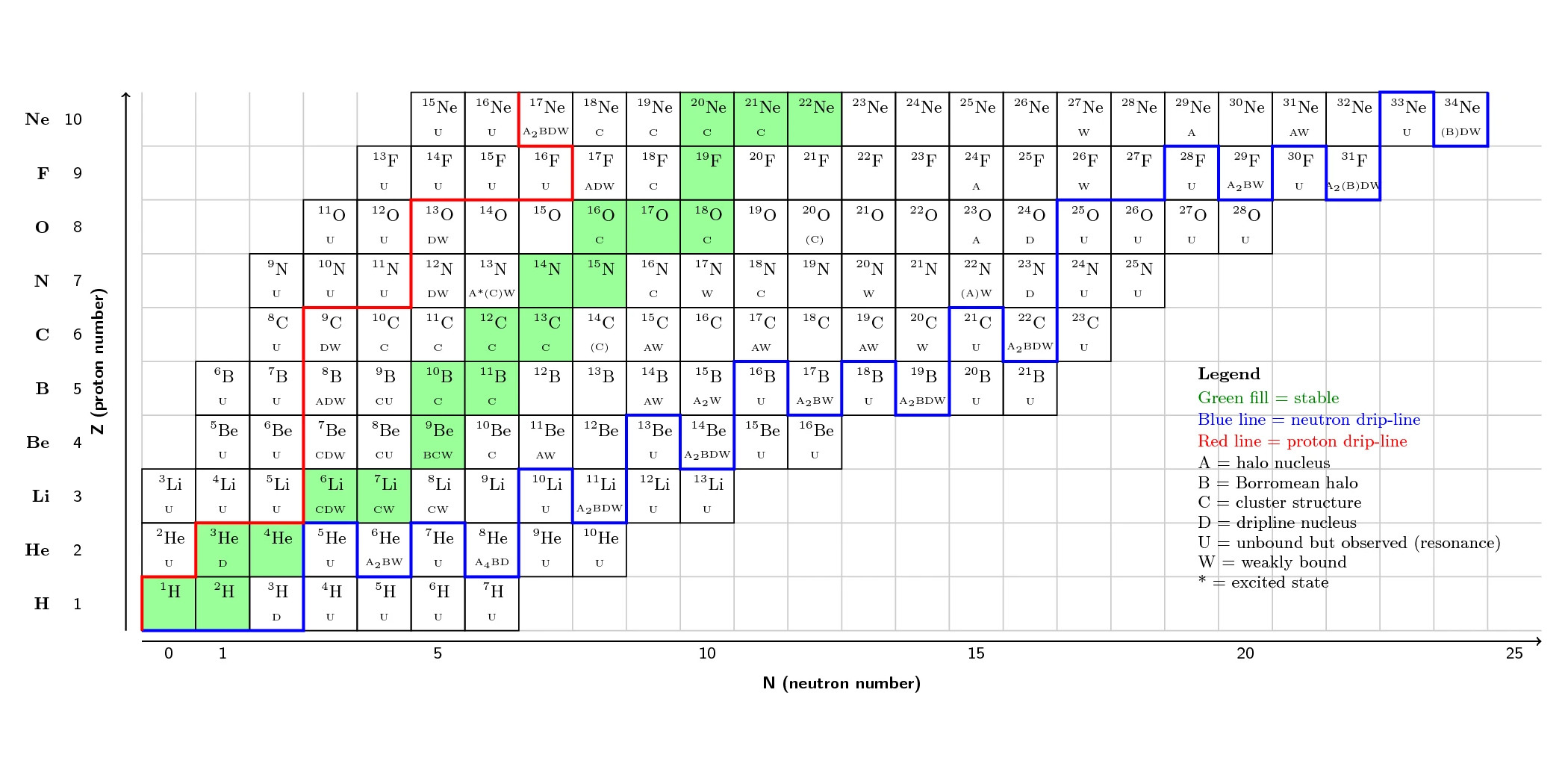
The system proposed by the researchers, called the ABC classification, describes the properties of unstable isotopes using letters that symbolise specific characteristics:
- A: the characteristic of the nuclear halo (from the Italian “alone”) – this determines the number of particles orbiting the main part of the atomic nucleus. Examples include the isotopes of helium: 6He, in which the nucleus takes the form of an α particle with two neutrons orbiting it, would be described as A2, while the isotope 8He would be described as A4,
- B: derived from the structure of Borromean rings in knot theory. A nucleus is described as Borromean if it consists of three components, where any two of them do not form a bound system. Taking the isotope 6He as an example, neither the α particle and a neutron nor the two neutrons form a bound system, so the isotope is classified as Borromean (B).
- C: characterises nuclei composed of clusters, i.e. groups of more than one nucleon. Such a structure is assumed for certain light nuclei, such as 7Li (assumed to be an α + t model) or 8Be (as 2α).
- D: (from “dripline”) defines the point of zero neutron or proton separation energy, that is, the point beyond which we do not expect nuclei to exist in a bound state
The proposed new classification also includes additional symbols that describe other characteristics of isotopes, e.g.:
- U: (from “unbound”) refers to isotopes that have been observed experimentally but are not a bound state. An example is 8Be, which exists as a resonance state for a very short time, yet is a significant component of the nucleosynthesis process.
- W: (from “weakly bound”); in the case of exotic isotopes, the binding energy may be significantly lower than for typical bound nuclei. As it is not possible to identify a precise boundary separating “strongly” and “weakly” bound isotopes, the authors of the system have proposed a threshold of 2.5 MeV as a compromise.
Under this system, isotopes can be classified as follows: 8He: A4BDW, 11Li: A2BDW. For nuclei whose properties have not been experimentally verified, the relevant part of the classification may be given in parentheses. This classification system has also been designed with future expansion in mind. “Above all, the solution we have developed may reveal new patterns that may previously have been hidden in the nuclear chart. As the number of discoveries grows, classification gaps become inevitable, just as in the original periodic table. New classification systems, tools and techniques will, over time, make it possible to fill these gaps,” explains Dr Gagandeep Singh, Assistant Professor at the Nuclear Physics Division of the National Centre for Nuclear Research (NCBJ) and one of the paper’s authors.
The research has been published in: Fortunato, L., Vitturi, A. & Singh, G. The ABC classification of exotic nuclei: a proposal. Eur. Phys. J. Plus 141, 1028 (2026). https://doi.org/10.1140/epjp/s13360-026-08229-9