English
 Polish
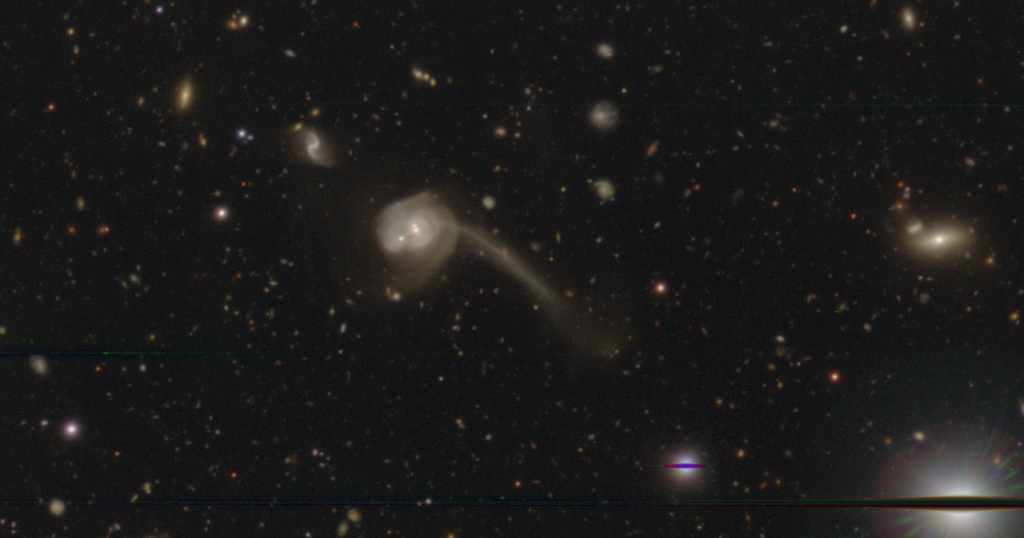
How to effectively identify galaxy mergers? NCBJ researchers compare morphological methods and machine learning
18-09-2026
Collisions and merging of galaxies is a key element of their evolution. In the era of large-scale sky surveys, effective methods for detecting these phenomena are essential. In their latest study, astrophysicists from the National Centre for Nuclear Research compared the effectiveness of morphology-based methods with the latest techniques using machine learning.
The process of neighbouring galaxies merging is the source of many key astrophysical phenomena. The interaction of such enormous masses of matter leads, in particular, to an intensification of star-formation processes and the formation of active galactic nuclei. The merging galaxies also form entirely new structures.
In the study of these phenomena, the precise classification of galaxy mergers is critically important. This is especially true in the context of ongoing sky surveys such as Euclid and LSST. These projects are generating unprecedented amounts of data, which must be properly processed to extract the information of greatest interest to researchers. In recent years, there has been a growing search for even more effective methods of classifying galactic collisions. Classical techniques, such as the close-pair method or visual classification, although effective, are not suitable for large datasets.
Most state-of-the-art methods are based on machine learning (ML), typically using convolutional neural networks or vision transformers. These are much better suited to processing vast amounts of data, but require equally substantial computational resources. What is more, classifiers trained on specific datasets tend to struggle with new data, which reduces their reliability. An alternative approach uses morphological classifiers, which are based on a set of statistics describing the shape of galaxies.
In their newest paper, which has just been published in the journal Astronomy & Astrophysics, a team of researchers from the Astrophysics Division of the National Centre for Nuclear Research (NCBJ) compared the performance of classifiers using morphological statistics with modern machine learning-based methods. Both simulated and real observations from the HSC-SSP programme were used to evaluate the classifiers. The study also involved optimising the criteria used by the classifiers to identify galaxy mergers, for which the Markov Chain Monte Carlo (MCMC) method was employed. The analysis also examined how classification accuracy depends on the redshift (z) and stellar mass.
– The findings confirmed that morphological classifiers are capable of detecting mergers in previously unseen datasets with similar accuracy to ML methods. Our analyses showed that such classifiers perform better at low redshifts and for higher stellar masses. Furthermore, the research has enabled us to redefine and optimise the criteria for detecting colliding galaxies, thereby eliminating the bias observed in some of the criteria used in previous studies – explains Aidan Cotter, a PhD student at the Astrophysics Division at NCBJ and the study’s first author.
The researchers will continue their work on refining the developed methods. Further research aims to increase the precision of detecting post-merger galaxies by introducing new morphological statistics.
Developing effective methods for detecting phenomena such as galaxy mergers will enable us to make full use of new data from large sky surveys. Analysing this data will lead to new discoveries that will help us better understand the evolution of the Universe.
The research was carried out as part of the SONATA grant "Smashing galaxies into dust", funded by the National Science Centre (UMO-2023 2023/51/D/ST9/00147).
The research results are available in the publication: A.P. Cotter et al., Performance of morphological classifiers for galaxy mergers compared to current machine learning methods, Astronomy&Astrophysics, 2026.