English
 Polish
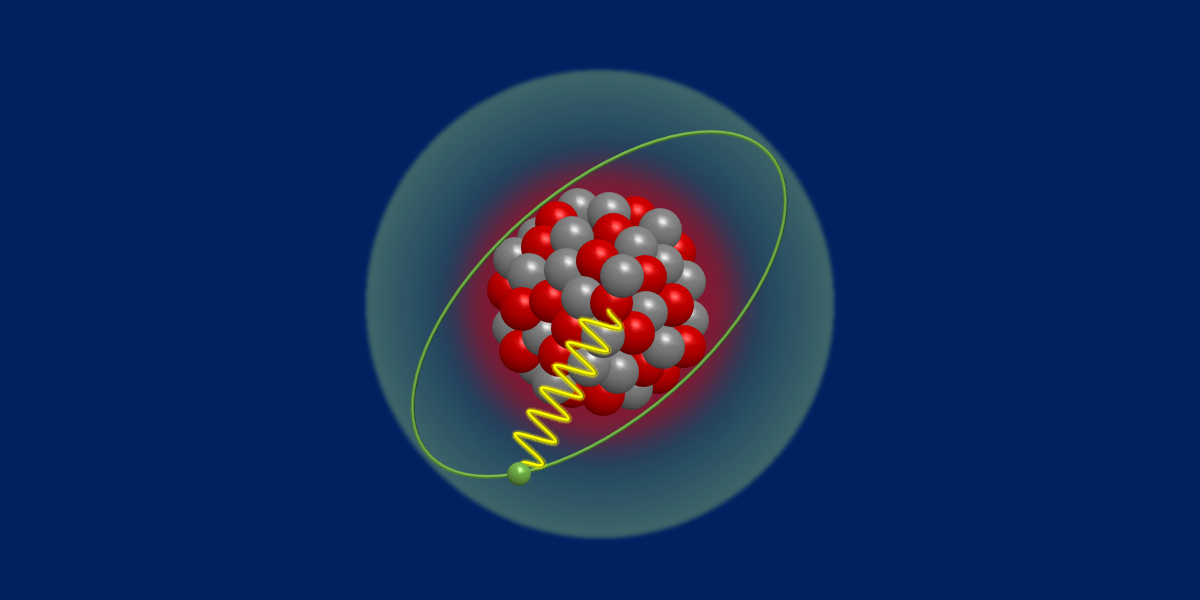
NCBJ scientists solve half a century old mystery of the Lead-208 nucleus
20-07-2026
Lead-208 is one of the most studied and best understood nuclei. However, there remain a few mysteries concerning its structure. In their most recent paper, scientists from the Nuclear Physics Division at NCBJ proposed a solution to a half a century old question concerning the strength of the transition from the first 2+ excited state of 208Pb to its ground state.
As one of the most widely investigated nuclei, lead-208 plays a special role in nuclear structure studies. Despite its apparent simplicity, the structure of 208Pb is still not completely understood and there remain theoretical and experimental challenges. One of them, unexplained for more than 50 years, pertains to the process of the inelastic scattering of light ions, mainly 12C and 3He. The parameter describing the strength of the transition from one of the low-lying excited states of lead-208 (the 4.086-MeV 2+ level) to its ground state (0+ level) extracted from theoretical analyses of these data was approximately twice the generally accepted value obtained from a wide range of other studies.
This discrepancy cannot be accounted for by errors in data normalization or the uncertainty in the adopted value of the coupling strength, since they are not enough to cause a disparity of a factor of two. That is why researchers from the Nuclear Physics Division at the National Centre for Nuclear Research (NCBJ) started looking for other causes that might contribute to the experimentally observed values.
They focused their attention on the relatively high level density for excitation energies around the 4.086-MeV 2+ excited state of 208Pb. Many of these levels differ only by tens of keV, which can have an effect on experiments, where the energy resolution may be up to 250 keV. This means that the experimental data may contain significant contributions from states close to the studied 2+ level.
– We propose a solution to this mystery by considering potentially unresolved states lying in the vicinity of the 2+ level, which is at 4.086 MeV above the ground state. Different projectiles were used to confirm the results and a consistent picture was obtained for proton, deuteron, Helium-3, alpha and Carbon-12 scattering from 208Pb. It turns out that the weak, unresolved levels close to the 4.086-MeV 2+ state can contribute up to about 50% of the total observed strength, with the 4.324-MeV 4+ level being the main contributor – explains dr Gagandeep Singh from the Nuclear Physics Division at NCBJ, first author of the paper.
Since the energy resolution of previous experiments on inelastic scattering of light ions on lead-208 cannot be confirmed with the available information, the definitive confirmation of the proposed solution requires entirely new measurements.
– This type of research is particularly important, since it shows the significance of lesser known regions of excitation energy. Their contribution may be crucial in both explaining the inconsistencies of the supposedly well understood nuclei, as well as studying their weakly bound isotopes – concluded dr hab. Nicholas Keeley, the chief investigator from the Nuclear Physics Division at NCBJ.
The original publication: Proposed resolution of the anomalous strength in the 0+1→2+1 quadrupole transition in 208Pb, G. Singh, N. Keeley, and K. W. Kemper, Phys. Rev. C 114, 014625; DOI: https://doi.org/10.1103/lxhy-wtr3