English
 Polish
Researchers from NCBJ and CEA develop a new method for testing materials for nuclear reactors
23-07-2026
Researchers from the NOMATEN Center of Excellence at the National Center for Nuclear Research and CEA Paris-Saclay have developed a multiscale method for determining the mobility of radiation defects induced by ionizing radiation. This new approach combines numerical simulations, hydrodynamics, and experimental data, and serves as a new tool for determining the behavior of materials exposed to radiation, such as in nuclear reactors.
It is well known that when a material is bombarded with charged particles or neutrons, new microstructures form, the presence of which can alter its mechanical properties, ultimately leading to its degradation. This is particularly important in nuclear power plant components, where radiation resistance is a key issue from the perspective of operational safety. Modern experimental techniques allow for the direct observation of such microstructural changes, and depending on the method chosen, studies can be conducted under precisely controlled conditions (type and dose of radiation, temperature, etc.). Simulations and modeling of real-world processes are commonly used to complement experiments. In the case of radiation-induced damage, the challenge lies in both its size (ranging from nanometers for individual microstructures to meters for entire components) and its timescale (ranging from picoseconds to decades). An alternative may be the Phase Field method, which requires fewer parameters than kinetic Monte Carlo simulations.
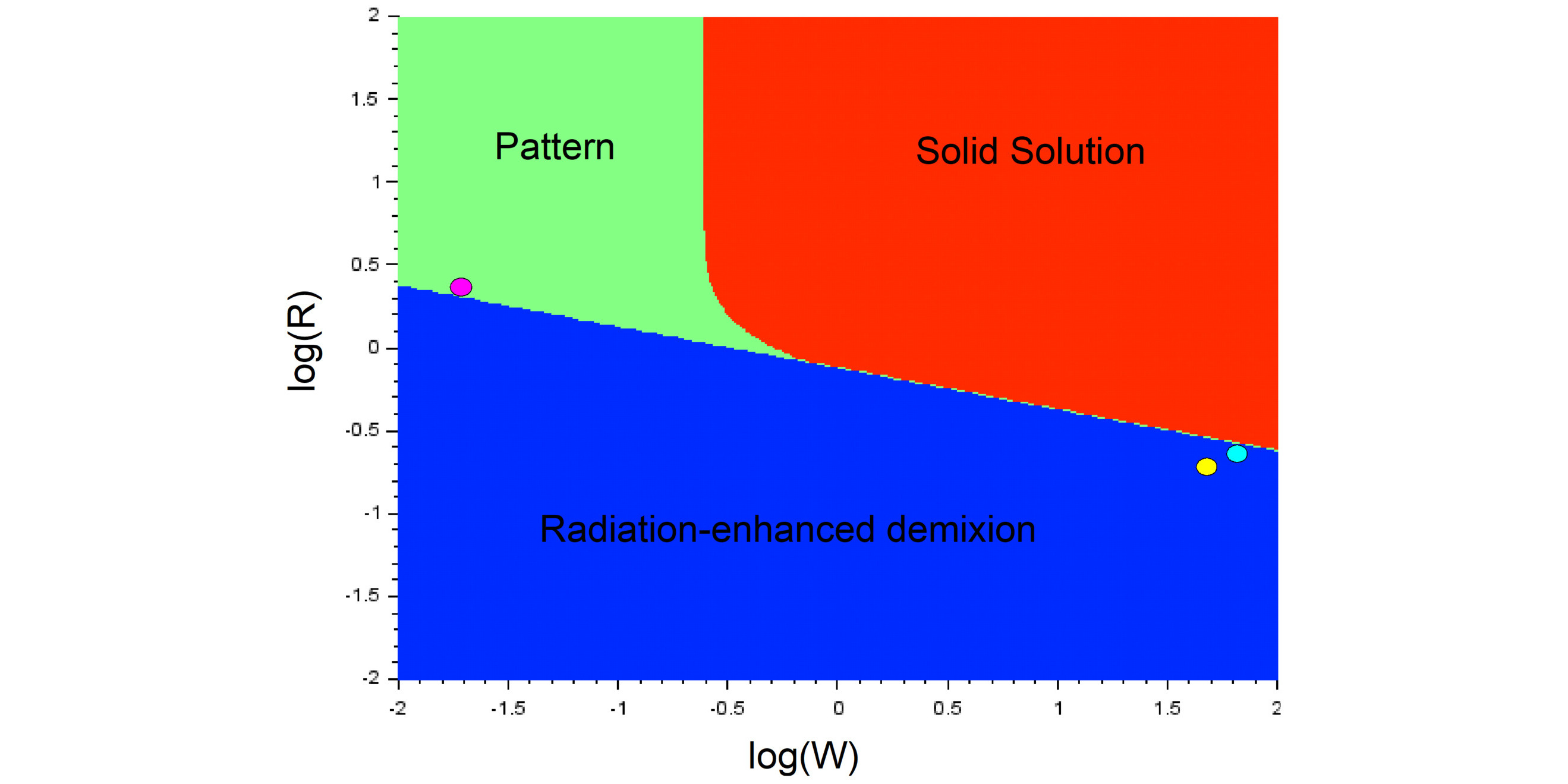
In a new study recently published in the prestigious journal Acta Materialia, a group of scientists from the NOMATEN Center of Excellence at NCBJ and CEA Paris-Saclay combined Molecular Dynamics (MD) simulations, the Phase Field method using hydrodynamics, and experimental measurements performed using Atom Probe Tomography (APT). The innovation in the published study was the determination not only of the stable states of radiation-induced defects but also of their kinetics. This made it possible to investigate radiation-induced mobility in the material and to better understand the process of defect microstructure formation. The research was conducted on an ultrapure FeCr alloy modified with iron ions. This alloy is commonly used to model the behavior of ferritic-martensitic steel, which is considered one of the most promising structural materials for future Generation IV nuclear reactors.
– Our method makes it possible to determine the mobility of radiation-induced defects, which is usually a challenge due to the large number of parameters required to describe this phenomenon. The multiscale approach presented in this paper utilizes atomic-level numerical simulations while also relying on experimental data. This allows us not only to obtain information on the formation of microstructures resulting from radiation exposure but also to trace their kinetics. In the case of FeCr, our method explains why chromium-rich regions appear only at low temperatures and under the influence of low radiation flux – explains dr hab. Francisco Javier Dominguez Gutierrez, head of the research group at the NOMATEN Center of Excellence at NCBJ.
The new approach was designed to be applicable to a variety of materials. The confirmation of its effectiveness for FeCr alloy indicates that the developed tool can be used to study the effects of radiation on, among other things, other structural components or even the fuel itself in nuclear reactors. With a better understanding of the radiation-induced phenomena, both current and future nuclear technologies will be safer.
The research results are available in the publication: D. Simeone, B. Mahe, F.J. Dominguez-Gutierrez, O. Tissot, L. Luneville, An experimental-based multiscale method for calculating radiation-enhanced mobility in solids: Application to radiation-induced microstructure in FeCr, Acta Materialia, Volume 317, 2026, 122514, ISSN 1359-6454, https://doi.org/10.1016/j.actamat.2026.122514.
This work was conducted within the framework of the NOMATEN project, which brings together two strategic partners, NCBJ and CEA, fostering long-term collaboration.