English
 Polish
Scientists at the NCBJ have developed a new model of positronium decay
08-09-2026
Imaging using positronium represents a promising extension of positron emission tomography (PET). However, its application requires a precise understanding of positronium’s behavior, which Monte Carlo simulations help to provide. A team from the National Center for Nuclear Research, in collaboration with researchers from Jagiellonian University as well as from France and Austria, has created a model that accurately reproduces its decays.
PET is an imaging technique based on the annihilation of positrons with electrons present in tissues. Positrons are antiparticles that are produced during the decay of a radioactive tracer administered to the patient. This phenomenon results in the creation of a pair of photons traveling in opposite directions. Detecting these pairs allows for the identification of the site of annihilation—that is, the location where the tracer accumulates, which most often indicates pathological changes. The technique enables imaging of both the structure of tissues and organs and their function, making it possible to detect changes at an early stage, which increases the effectiveness of subsequent treatment.
In recent years, techniques that extend classical PET have garnered significant interest; these utilize positonium—an exotic atom composed of an electron
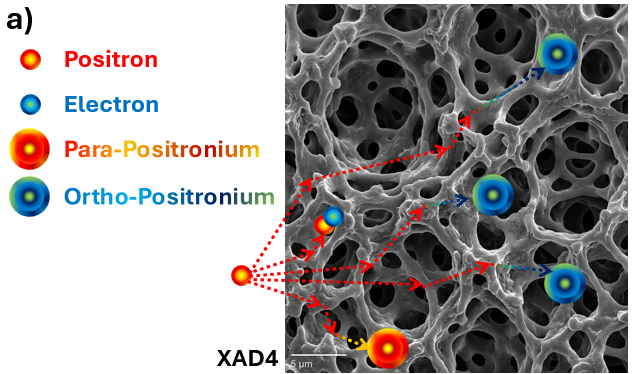
and its antiparticle, the positron. It behaves like a tiny probe: when placed inside a material, it survives longer the more free space it has around it. By measuring this time, it is possible to determine the composition and microstructure of tissues. Laboratories have been using this probe for decades as part of the PALS (positron annihilation lifetime spectroscopy) technique, but they obtain only an average value for the entire sample. What is new is the ability to perform point-by-point measurements and obtain a three-dimensional image.
To ensure the safety and effectiveness of new imaging techniques, advanced simulations and models are required that precisely describe the behaviour of the particles used. These are needed during the design of the equipment, image reconstruction, the development of correction algorithms, and the optimisation of data acquisition. One of the most widely used tools in nuclear medicine is GATE – an open-source Monte Carlo simulation package. It allows for the accurate simulation of imaging systems, radioactive sources and their decays, as well as the movement of detectors.
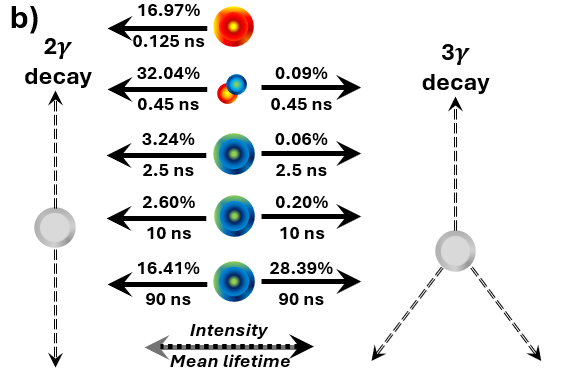
However, the modelling of positronium decay was implemented in it in a simplified manner: it was limited to two decay channels — as if there were only one or two types of internal voids in each material. Real materials, however, contain a mixture of all of them. Existing algorithms that precisely model positronium decay were, in turn, tailored to specific detector geometries.
A group of scientists from the National Centre for Nuclear Research and the Jagiellonian University, in collaboration with researchers from the University of Lyon, IT:U in Linz and the University of Vienna, has therefore set out to develop a new model of positronium decay for general use, implemented within the GATE framework.
“We have designed the new model to be flexible and modular. It allows users to define new decay channels and their parameters, thereby making it possible to fully capture the complexity of positronium decay in matter,” explains Dr Wojciech Krzemień from the Department of High-Energy Physics at the NCBJ, the lead author of the publication. The new solution is particularly significant for the technique of positronium lifetime imaging (PLI), for which accurate simulations were previously unavailable. Interest has grown rapidly: research groups from the United States and companies developing imaging equipment have already begun testing the proposed model.
Tests have shown that the model accurately reproduces the lifetime of positonium, its decays and the properties of the resulting photons. The researchers also tested its performance in simulations of sources placed within a phantom modelled on human tissues — bone, muscle, fat and water.
“Our implementation is fully compatible with GATE standards and is publicly available. This tool can be used to investigate various positron-based imaging methods,” adds Dr Krzemień.
The solution developed represents the first positronium decay model adapted for general use. The model can be applied in techniques such as PLI and PET, for both medical and industrial imaging. At the NCBJ, the tool is being further developed as part of the IMPET project, which focuses on industrial applications.
The current version of the model leaves scope for further improvements, which will make it possible to simulate the state from positron emission, through the formation of positonium, right up to its decay. Even now, however, it is a precise tool for studying this exotic atom.
The full results of the study are available in the following publication: Krzemień W, Bala M, Dulski K, Zdeb WB, Coussat A, Hiesmayr BC, Klimaszewski K, Obara M, Raczyński L, Shopa RY, A Monte Carlo positronium decay source model with multiple annihilation channels in GATE, Phys Med Biol. 2026, DOI: 10.1088/1361-6560/ae9c83.