English
 Polish
Scientists peer deep into matter: groundbreaking results from the Large Hadron Collider
27-03-2026
Researchers working on one of the world’s largest scientific experiments – CMS at the Large Hadron Collider (LHC) – have announced new findings on how the fundamental building blocks of matter behave. The analysis utilized, for the first time, the latest data collected at CERN between 2022 and 2024. Scientists from the National Research Centre for Nuclear Physics also played an important role in this work.
Scientists are studying what happens when protons — the particles that make up atoms — collide with each other at extremely high energies. Under these conditions, other, very short-lived particles are created, which help us understand the laws that govern the universe at the most fundamental level.
One of the phenomena being analyzed is a situation in which particles created in a collision interact with each other before they separate. Although such cases are extremely rare, they are invaluable to physicists — they allow us to test whether the current theory describing nature (the so-called Standard Model) is truly complete.
– Since the LHC collision energy is not expected to rise dramatically in the near future, the most promising path forward is to exploit larger datasets and improve analysis techniques to study rare Standard Model processes with high precision, and vector boson scattering (VBS) is one such rare process providing strong sensitivity to new physics effects – says Monika Ghimiray, a doctoral student from High Energy Physics Division of NCBJ.
In their latest research, scientists have focused on specific cases in which certain combinations of particles are produced. These are difficult to detect, which is why they require very careful data analysis and advanced statistical methods.
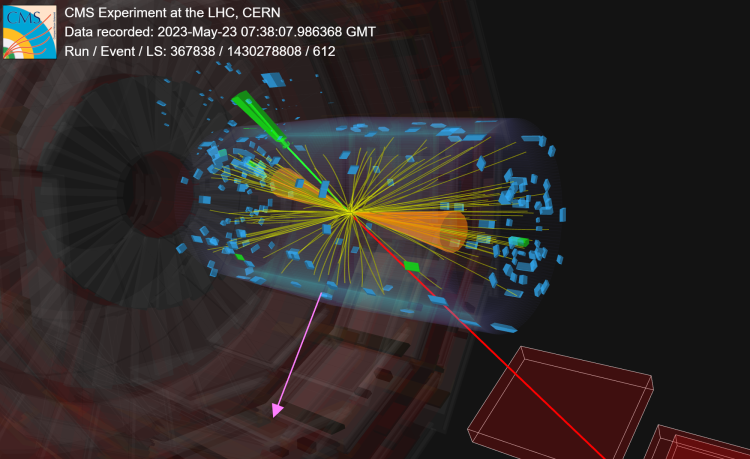
To detect such events, researchers analyze the traces left in the detectors. They look for, among other things, characteristic sets of particles — such as electrons or muons — and so-called jets, which are streams of particles produced at high energies. Another important signal is the presence of invisible particles (neutrinos), which reveal their presence through a missing energy component in the measurements.
Thanks to the use of modern analytical methods, the phenomena under study have been clearly observed. What is important is that the results are consistent with the predictions of current physical theory. This means that our current understanding of fundamental interactions still accurately describes reality — even at the highest energies available.
However, this is not the end of the research. Scientists emphasize that as more data becomes available, they will be able to test their models even more thoroughly. Perhaps in the future, they will be able to detect minor deviations from the theory that point to the existence of new, previously unknown phenomena.
A scientific paper detailing this research is expected to be published in the coming months.