English
 Polish
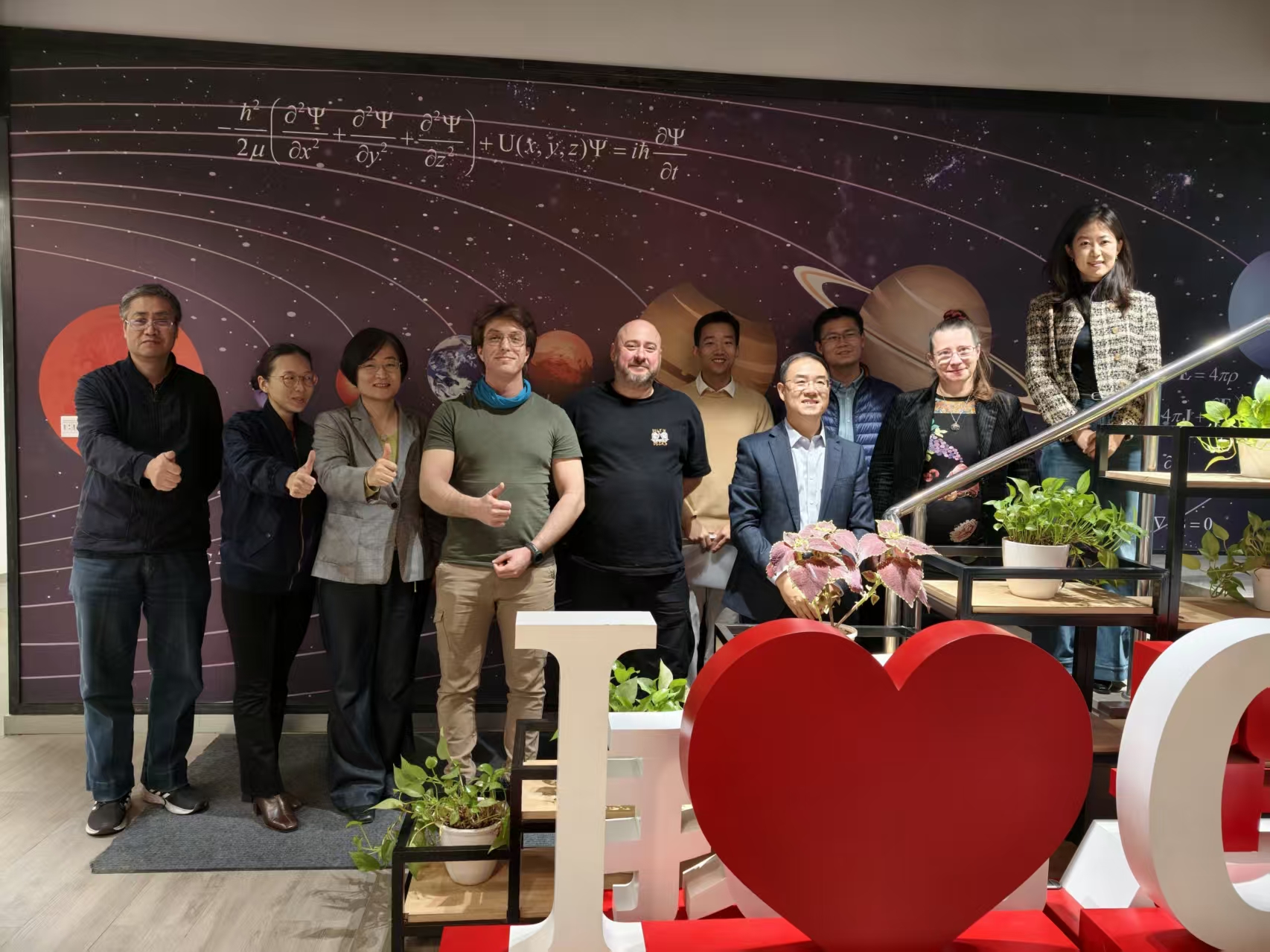
Visit to the Technology and Engineering Centre for Space Utilisation of the Chinese Academy of Sciences
12-12-2025
On 16 November 2025, a delegation from the National Centre for Nuclear Research, consisting of Prof. Agnieszka Pollo, NCBJ Deputy Director for Science and POLAR-2 Project Manager on the Polish side, Dominika Rybka, MSc Eng., project coordinator, and Grzegorz Łubian, Eng., visited the Centre for Space Technology and Engineering (CSU) of the Chinese Academy of Sciences.
The hosts presented the infrastructure for testing instruments to be installed on the Chinese Space Station, including the Ground Analog System of CSS. The guests also learned about the functioning of the Payload Operation and Application Centre, responsible for communication with the station and supervision of its operation.
CSU Deputy Director Prof. Congmin Lyu and CSU International Cooperation Centre Director Mengyun Chen presented the CSU's research profile and key projects carried out as part of international cooperation. Prof. Agnieszka Pollo presented the NCBJ's expertise in areas related to space research, including astrophysics, the construction of high-energy radiation detectors and high-energy physics. The talks focused on potential future joint initiatives, from low-orbit missions to ambitious projects related to lunar exploration. The importance of regular knowledge exchange and the potential for expanding cooperation to new areas of research were emphasised.
POLAR-2 is an international space project selected in 2019 as part of a joint competition organised by UNOOSA and CMSA as one of six experiments to be carried out on the Chinese space station. Its task is to precisely measure the polarisation of cosmic gamma-ray bursts – some of the most powerful explosions in the Universe, associated, among other things, with hypernova explosions and neutron star collisions. The project is being carried out by an international consortium of institutes from Switzerland, Poland, Germany and China. NCBJ is responsible for key on-board electronics, including the computer and low-voltage power supply system, and the Polish leader is Prof. Agnieszka Pollo, supported by the technical coordinator of the project, Dominik Rybka, MSc Eng. Once in orbit, the instrument will record approximately 250 GRBs per year, with accurate polarisation measurements for about 30 of them.