English
 Polish
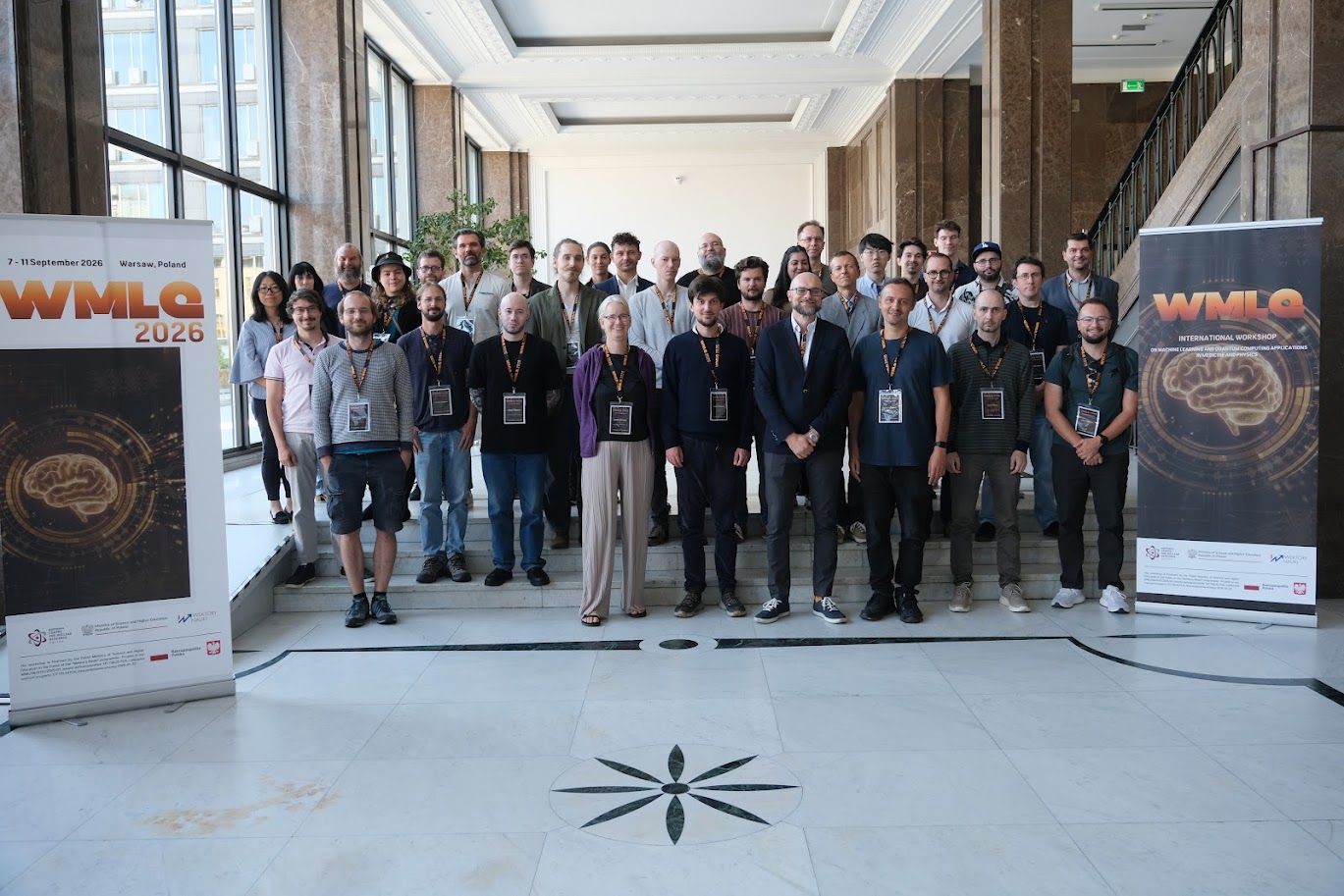
WMLQ2026 is now complete!
23-09-2026
What do research into galaxy collisions have in common with cancer treatment? More than one might think. In September, Warsaw hosted physicists, medical imaging specialists and computer scientists from Europe, Japan and the US. The third edition of the International Workshop on Machine Learning and Quantum Computing Applications in Medicine and Physics demonstrated once again that the same tools can solve completely different problems. Metody opracowane do analizy danych z teleskopów czy akceleratorów cząstek coraz częściej trafiają do szpitali, i odwrotnie. Methods developed for analysing data from telescopes or particle accelerators are increasingly finding their way into hospitals, and vice versa.
What did we discuss?
The Universe and Particles
New telescopes and surveys of the sky are providing millions of spectra and images of galaxies, which humans are unable to examine on their own. Artificial intelligence analyses thousands of spectra in a matter of seconds and identifies galaxy collisions. In particle physics, AI generates simulations of proton collisions observed at the LHC, which would require enormous supercomputer resources using classical methods. We also discussed just how valuable such “artificially generated” data really is. Among other things, a model was presented that simulates the behaviour of particles in a detector almost a hundred times faster than the best solutions to date. It was also demonstrated how optimisation methods – which form an integral part of machine learning – can be used to design next-generation detectors.
Medicine and industrial imaging
A small AI model was demonstrated which, in a matter of seconds on an ordinary laptop, assesses the condition of children’s sinuses based on CT scans, without the need for expensive equipment. Faster and more accurate radiotherapy planning, improved image quality from CT and PET scans, and methods for monitoring proton therapy – which, in simulations, indicated the beam’s range with sub-millimetre accuracy – were discussed. The effectiveness of technology transfer between the medical and industrial sectors was highlighted.
The quantum world
Quantum computers utilise phenomena that seem impossible in everyday life, such as particle entanglement. We discussed what “information” actually is and how it links machine learning, medical imaging and quantum computing. Presentations covered the first attempts at quantum detection of brain tumours in MRI scans, quantum methods for reducing satellite data, and how entanglement manifests itself in elementary particle collisions.
Supercomputers
Behind every large AI model lies a powerful computing infrastructure. We discussed European supercomputers and so-called AI factories, which are designed to make it easier for researchers and companies to access computing power, as well as the challenges faced by computing centres supporting a wide variety of applications.
Learning about science
Large language models can assist in preparing meta-analyses – that is, summaries of the results of multiple studies – which are the gold standard in medicine. At the same time, the rapidly growing number of publications written with the help of AI is placing an ever-greater strain on the peer-review system. This is one of the most significant challenges facing the scientific community today.
Practical workshops
Participants were also able to gain specific skills: an introduction to quantum computing was led by experts from the Poznań Supercomputing and Networking Centre, whilst the NCBJ team demonstrated how to accelerate AI models using graphics cards. We would like to thank all the speakers, participants and workshop leaders for their excellent presentations and lively discussions during the breaks! Special thanks to the co-organisers: the University of Vienna, Jagiellonian University, the CREATIS laboratory, the Institute of Solid State Physics (IFJ) of the Polish Academy of Sciences, and IT:U Austria.
The workshops were funded from the state budget allocated by the Minister of Science and Higher Education as part of the “Wektory Nauki” programme.
See you at the next edition!