English
 Polish
The faintest lights: Exploring the properties of the largest barely visible galaxies
16-10-2026
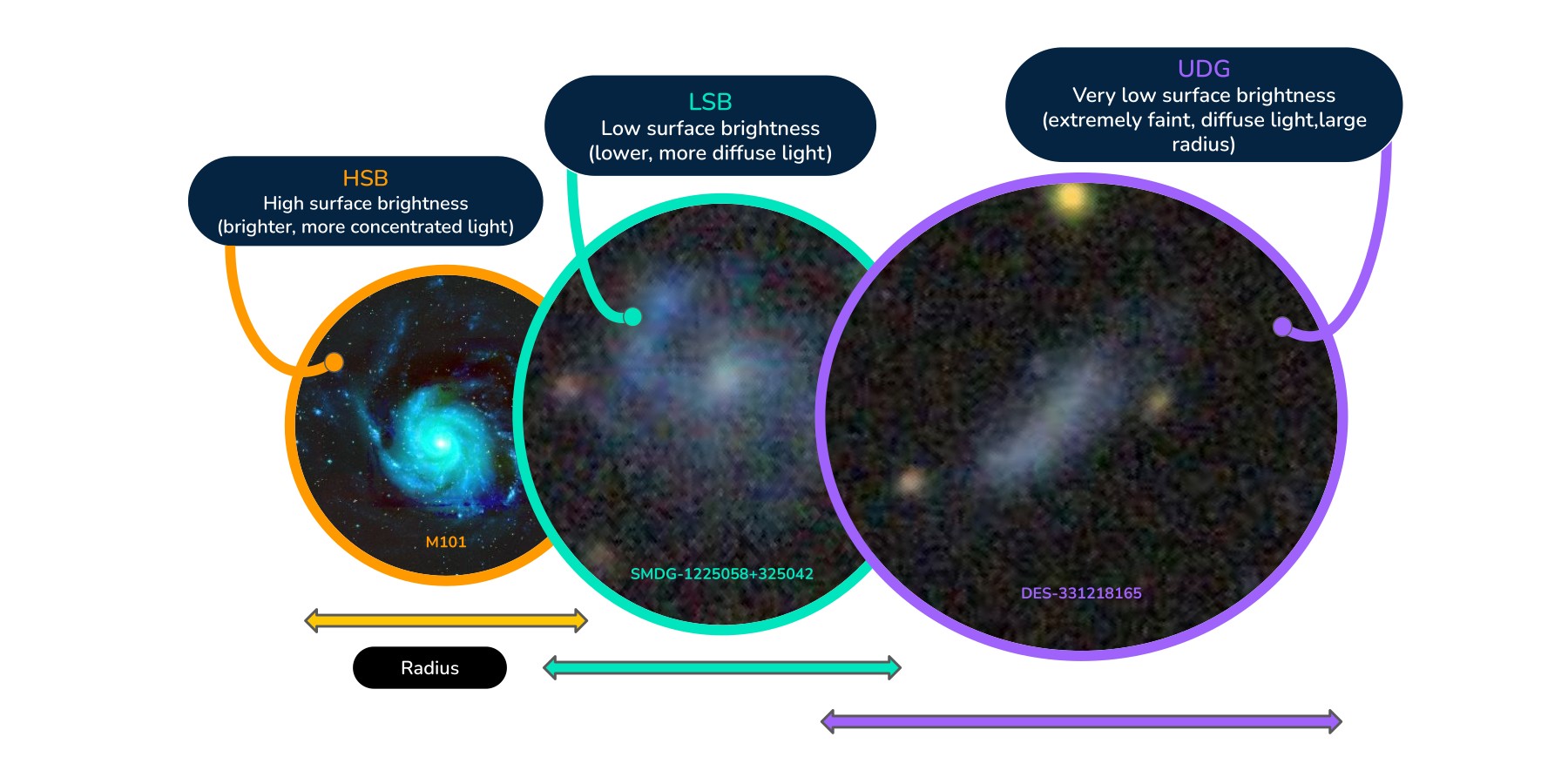
When we look up at the night sky, bright celestial objects naturally draw most of our attention. However, the cosmos also contains hidden objects that are important for understanding how galaxies evolve: low surface brightness galaxies (LSBGs) and Ultra-diffuse galaxies (UDGs). LSBGs and UDGs are fainter than the dark night sky, posing a major challenge for researchers to obtain clear measurements. Although they account for only 6~11% of the total luminosity of the observable Universe, it is estimated that they may constitute as much as 50% of the total number of galaxies. For this reason, it is crucial to understand their properties, as well as the history of their formation and evolution. In a newly published paper, a team of scientists from the Astrophysics Division of the National Centre for Nuclear Research, led by the PhD student Antonio Vanzanella, has investigated new candidates for UDG galaxies in order to confirm their nature and precisely determine their properties.
Despite advances in observational astronomy, LSBGs remain extremely difficult to detect. Their low surface brightness means that their light can be lost against the background of the dark night sky, making them challenging targets even for large astronomical surveys. However, new generations of telescopes which can observe fainter objects, and increasingly sophisticated data-analysis techniques are allowing researchers to detect and investigate objects that were previously hidden in the observational background.
A particular group of LSBGs are the so-called ultra-diffuse galaxies.
UDGs are of particular interest because they combine an unusually large size with a relatively low luminosity. Their properties can vary significantly depending on their environment. Many UDGs found in dense galaxy clusters are red and quiescent, whereas some UDGs in less dense environments are blue and actively forming stars. However, isolated UDGs exhibit a variety of properties, and their physical nature remains difficult to establish because of the challenges involved in obtaining spectroscopic observations.
Without spectroscopic measurements, it can be difficult to determine galaxy distances reliably and establish their physical sizes, luminosities and star formation properties. Spectroscopic confirmation is therefore an important step towards understanding the true nature of these faint galaxies.
A team of researchers from the Astrophysics Division of NCBJ focused on isolated UDG candidates identified in the Dark Energy Survey catalogue using machine-learning algorithms. Through additional observations and spectroscopic analysis, the researchers aimed to confirm the nature of these objects and determine key physical parameters, including their star formation rates (SFRs) and stellar masses. They also investigated how the galaxies compare with the star-forming main sequence, a relation linking the stellar masses and star formation rates of star-forming galaxies.
The observations were carried out at the Large Binocular Telescope Observatory using the Multi-Object Double Spectrograph (LBT/MODS) and at the Observatoire de Haute-Provence (OHP) using the MISTRAL spectrograph mounted on the T193 telescope. After applying the selection criteria, the researchers analysed 17 candidates for which they could obtain spectroscopic measurements and investigate their physical properties.
“Spectroscopic observations allowed us to determine the redshifts and measure emission-line fluxes, which we used to estimate the star formation rates. By combining these results with photometric data and spectral energy distribution modelling, we were also able to estimate the stellar masses of the candidates. After accounting for relevant effects and corrections, we confirmed that 9 of the 17 objects studied are UDGs. The remaining eight are other low-surface-brightness galaxies, including one giant low-surface-brightness galaxy (GLSBG), a subclass characterised by an exceptionally extended optical disc,” explains Antonio Vanzanella, a PhD student at the Astrophysics Division of NCBJ and lead author of the paper published in Astronomy & Astrophysics.
The study also highlights the importance of considering the dust attenuation when investigating these galaxies. Dust can absorb and scatter the light emitted by stars and ionised gas, affecting the interpretation of their observed properties. Accounting for this effect is therefore important when estimating star formation rates and characterising not only normal galaxies, but also low-surface-brightness systems.
These results demonstrate the importance of combining deep imaging with spectroscopic observations to investigate galaxies that are difficult to detect. By establishing the nature and physical properties of low-surface-brightness systems, the study provides new insights into the diversity of diffuse galaxies and the challenges involved in understanding their formation and evolution.
The full results of the research are available in the publication: A. Vanzanella, K. Malek, Junais, E. Bernaud, A. Gargiulo, H. Thuruthipilly, K. Lisiecki, A. Pollo, M. Scodeggio, P. M. Weilbacher, S. Boissier, P. Franzetti, G. Lorenzon, A. Nanni, C. Adami, R. Gavazzi, O. Ilbert, S. Pal, N. Principi Cavaterra, Dissecting ultra-diffuse galaxies in the field: Observational biases and spectroscopic determination of physical properties in low surface brightness systems, A&A, 714, A296 (2026), DOI: https://doi.org/10.1051/0004-6361/202660916.