English
 Polish
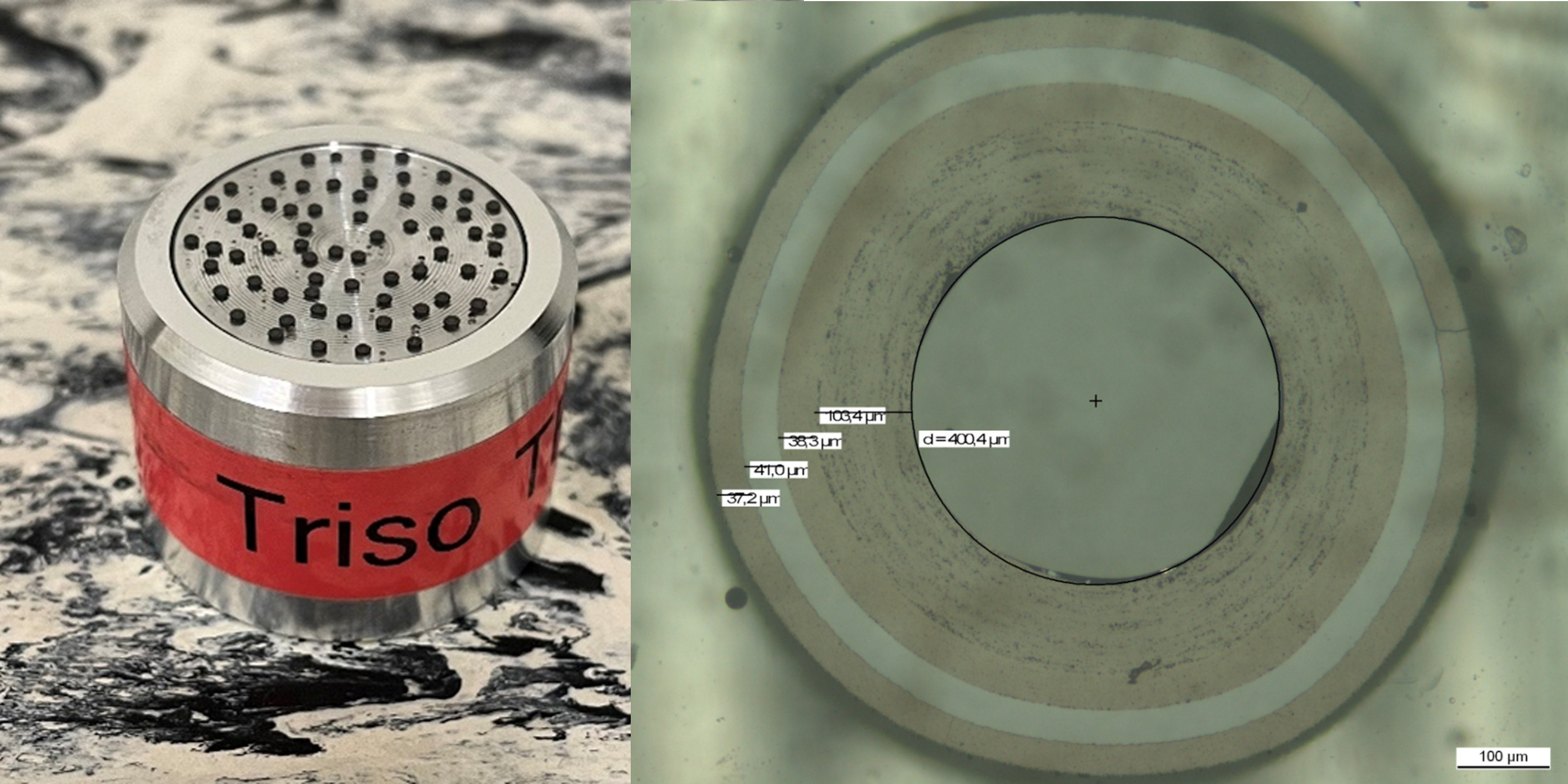
Researchers from NCBJ and JRC have developed procedures for testing the quality of TRISO fuel
21-10-2026
One of the key elements in ensuring the operational safety of future high-temperature reactors will be the testing of TRISO fuel, both before and after irradiation. Scientists from the National Centre for Nuclear Research and the European Commission’s Joint Research Centre have developed a procedure for preparing TRISO fuel samples for quality testing, which can be carried out in a laboratory or in hot cells.
The need for an energy transition provides an additional impulse for the development of new technologies. This applies, among other things, to the new generation of nuclear reactors, which includes high-temperature gas-cooled reactors (HTGRs). A key component of any reactor is the core, which contains the nuclear fuel. This fuel is not only the source of nuclear reactions but also serves an important safety function. Fuel elements are designed to retain fission products.
A characteristic feature of HTGRs is fuel in the form of pellets, known as TRISO (TRIstructural ISOtropic). These millimeter-sized pellets are embedded in a graphite matrix, which forms the reactor core (in the form of a bed composed of larger spheres or hexagonal elements arranged in a prismatic pattern). The TRISO fuel itself consists of a fissile core surrounded by four cladding layers, including pyrolytic carbon and silicon carbide. As a result, during reactor operation and in the event of an accident, fission products remain confined within the fuel.
Like any technological component, TRISO fuel can also be subject to damage, both during the manufacturing process and during reactor operation. To ensure the safe functioning of reactors, it is essential to thoroughly understand how damage and inhomogeneities affect fuel performance. Therefore, it is important to study TRISO fuel at various stages. Since such studies require access to the fuel’s internal layers, an additional procedure is necessary to expose their cross-section and provide insight into the entire internal structure.
“The goal of our study was to develop a universal procedure that explains, step by step, the methods for preparing fuel for polishing as well as the polishing process itself for TRISO samples, regardless of the irradiation stage at which we want to verify fuel quality” – explains dr inż. Zuzanna Krajewska-Travar, from the Division of Nuclear Energy and Environmental Studies at the National Centre for Nuclear Research (NCBJ), the author of the publication.
Researchers from the National Centre for Nuclear Research and the European Commission’s Joint Research Centre investigated various methods of embedding TRISO fuel pellets in resin to create a sample for polishing. The sample polishing procedure was designed to be applicable both in the laboratory (for TRISO samples prior to irradiation in a reactor) and in a hot cell (for testing irradiated fuel). The polishing materials were carefully selected, making it possible to obtain cross-sections of the samples that revealed all the layers coating the TRISO without damaging them. Fuel surrogates from various manufacturers were selected for the study, allowing for a comparison of the polishing quality of different fuel samples. The samples were then examined using optical microscopy to verify the quality of the polishing.
Microscopic observations of the prepared samples confirmed that the developed procedure provides insight into the individual layers of TRISO and allows for the assessment of manufacturing quality and any damage that may occur during operation. Further research will focus on the preparation of irradiated samples containing a uranium core.
The research results were published in the article: Z.M. Krajewska-Travar, E. Fontana, P. Lajarge, S. Gardeur, S. Pfirrmann, D. Freis, Polishing process of the TRISO particle fuel, Annals of Nuclear Energy, Volume 241, 2027, 112755, ISSN 0306-4549, https://doi.org/10.1016/j.anucene.2026.112755.