English
 Polish
Research into multiprincipal element alloys reveals the influence of atomic order on thermal properties
27-10-2026
Researchers from the NOMATEN Centre of Excellence at the National Centre for Nuclear Research (NCBJ), in collaboration with the Massachusetts Institute of Technology (MIT), the Łukasiewicz Research Network’s Institute of Microelectronics and Photonics (IMiF) and the AGH University of Science and Technology in Kraków (AGH), have investigated the influence of local atomic order and secondary phases on the thermal properties of a CoCrFeNi alloy. The results show that changes occurring at the atomic level can influence the behaviour of the material, and that spontaneously formed strengthening phases can enhance its potential for high-temperature applications.
Multiprincipal element alloys, including high-entropy alloys (HEAs), are the subject of intensive research due to their potential to exhibit favourable mechanical and physical properties. Their behaviour under working conditions is determined not only by their chemical composition, but also by the material’s structure, including local atomic ordering and the presence of secondary phases.
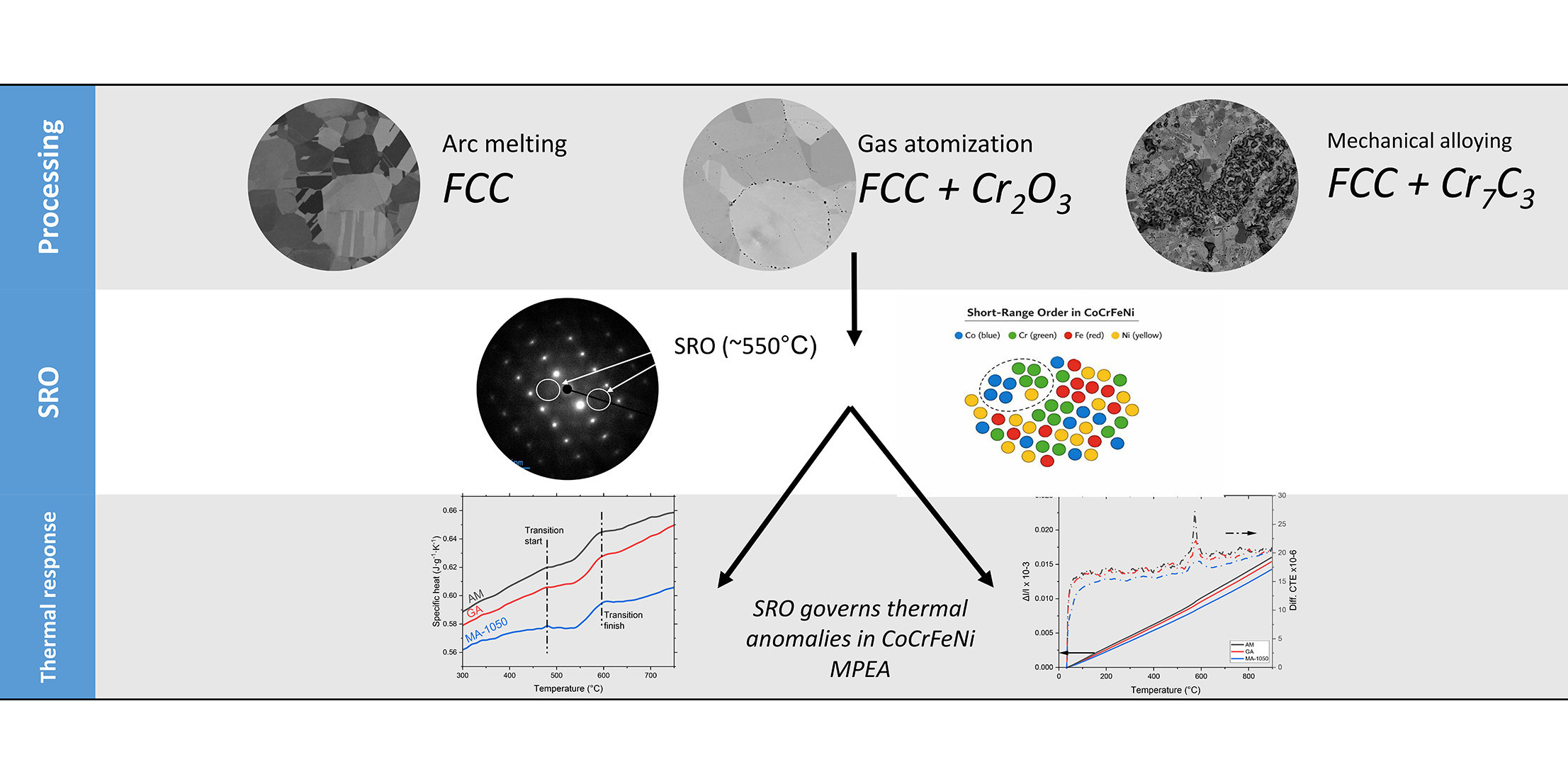
In an article published in the prestigious journal Acta Materialia entitled “The effects of short-range order and secondary phases on the thermal properties of a CoCrFeNi multiprincipal element alloy”, the influence of chemical short-range order (SRO) and secondary phases on the functional properties of a model CoCrFeNi alloy was analysed.
A key aspect of the study was the comparison of thermal property results obtained using laser flash analysis (LFA) with measurements from transient grating spectroscopy (TGS) and computational methods utilising molecular dynamics (MD). This provided a better understanding of the significance of crystallographic orientation, texture and material anisotropy in TGS measurements, in relation to the LFA results. This represents an important step towards applying this method to the study of the thermal properties of high-entropy alloys subjected to radiation, including ion beam-induced defects.
Differential scanning calorimetry (DSC) also provided important information; its results indicate the formation of short-range order (SRO) and its disappearance at a temperature of approximately 600°C. These changes are accompanied by a small but systematic shift in the slope of the temperature dependence of diffusivity and thermal expansion, observed in all the samples studied. This demonstrates that even subtle differences in the local atomic structure can influence how a material’s thermal properties change with temperature.
By contrast, the presence of spontaneously formed oxides and carbides has only a limited effect on the thermal properties. Their values remain comparable to those characteristic of traditional high-temperature materials, such as nickel alloys and steels. Combined with the improvement in mechanical properties demonstrated in the group's previous studies, this points to the potential for using such phases to strengthen alloys without significantly compromising their thermal properties.
The results highlight the importance of considering both local atomic order and secondary phases when designing new metallic materials for use in extreme operating conditions, such as high temperatures, pressures and radiation fields. A better understanding of these relationships may aid in the development of alloys that combine favourable mechanical properties with suitable thermal characteristics for high-temperature applications.
The research findings are presented in the publication: A. Olejarz, M. Brykała, K. Kowiorski, M. Chmielewski, G. Markovic, M. Rae Chu, W. Chromiński, P. Rutkowski, K. Suchorab, W. Chmurzyński, F.J. Dominguez-Gutierrez, M.P. Short, Ł. Kurpaska, The effects of short-range order and secondary phases on the thermal properties of a CoCrFeNi multiprincipal element alloy, Acta Materialia, Volume 322, 2027, 122876, ISSN 1359-6454, https://doi.org/10.1016/j.actamat.2026.122876.