English
 Polish
How can we describe Nuclear Fission?
14-10-2026
Four authors from the National Centre for Nuclear Research - Aleksander Augustyn, Tomasz Cap, Michał Kowal, and Krzysztof Pomorski - have compared two methods for describing nuclear fission. Their paper has just been published in Physical Review C and selected by the editors as an Editors’ Suggestion.
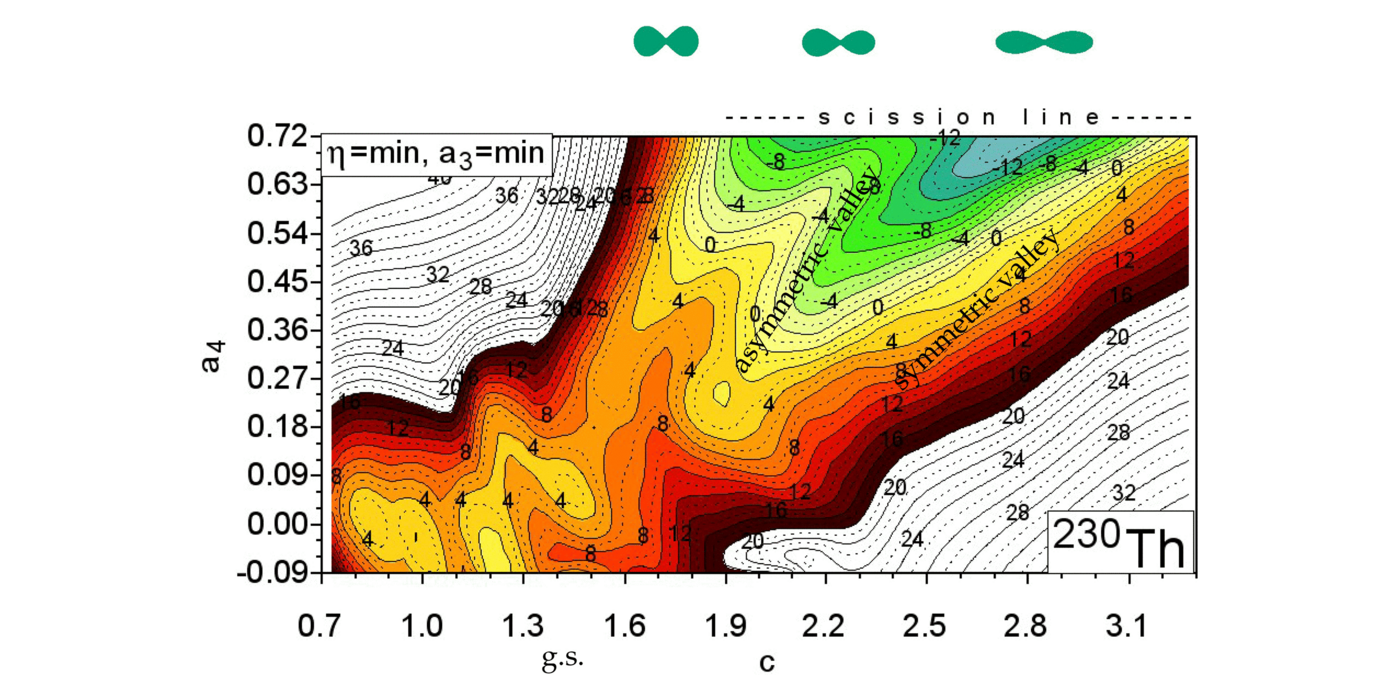
During fission, a heavy nucleus splits into two lighter fragments. Before this happens, it elongates, and an increasingly narrow “neck” forms at its centre. Physicists can picture the process as a journey across a potential-energy map resembling a topographic map of hills and valleys. A position on this map represents a particular nuclear shape, while its height represents the energy of the system at that shape. The valleys mark different routes to fission: some lead to fragments of similar mass (symmetric fission), others to fragments of different masses (asymmetric fission).
The motion of nuclear matter associated with changing shape is strongly damped, while random fluctuations affect how it proceeds. The authors compared two ways of accounting for these effects: Langevin dynamics and the Metropolis random walk. The first includes inertia, friction, and a random force. The second describes successive random changes in shape without tracking momentum. Both methods were applied to the fission of six different actinide nuclei, from thorium to fermium, induced by the absorption of a thermal neutron. The calculations used the same energy surfaces.
The researchers showed that the random walk corresponds to a limiting case of Langevin dynamics under very strong damping. Under appropriately matched conditions, the two methods produce nearly identical fragment mass distributions for the lighter nuclei studied. Differences appear for the heavier nuclei: Langevin dynamics predicts a noticeable contribution from splits into fragments of similar mass that is absent from the random-walk results.
Both methods approximately reproduce the positions of the peaks in measured fragment mass distributions, but predict distributions that are too narrow. This may indicate that a more accurate description requires additional ways for the nucleus to deform. The results help establish when the faster random-walk method is sufficient and when a fuller dynamical description is needed. They form part of Aleksander Augustyn’s doctoral research.
The results of the research are available in the publication: A. Augustyn, T. Cap, M. Kowal, K. Pomorski, Comparative study of Langevin and random walk models for nuclear fission in the overdamped regime, Phys. Rev. C 114, 044614 (2026), DOI: https://doi.org/10.1103/tnt4-6wbh