English
 Polish
NCBJ astrophysicists advance understanding of distortions in the Cosmic Microwave Background
24-07-2026
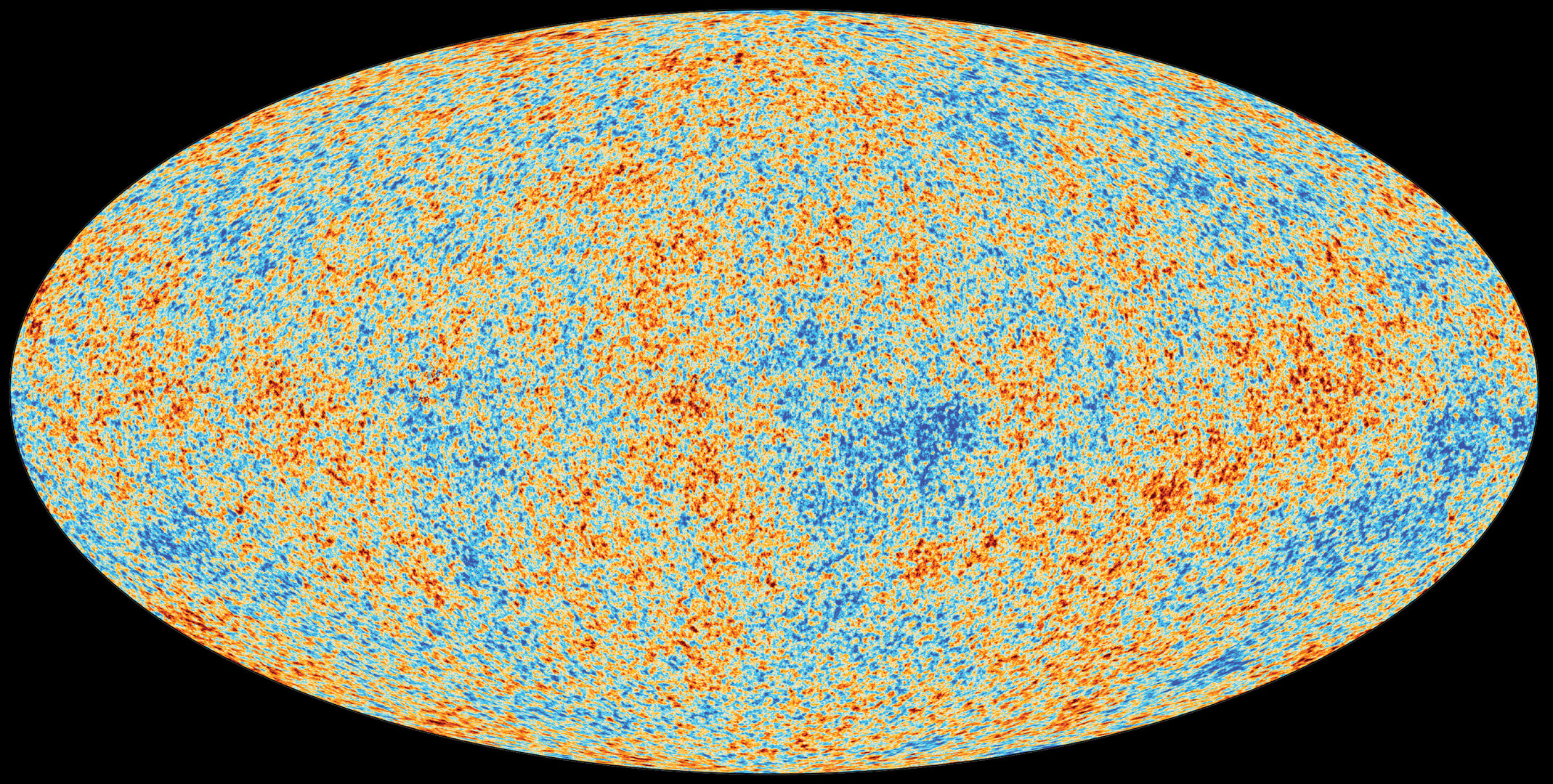
The Cosmic Microwave Background (CMB) contains key information about the earliest stages of the Universe's evolution. In a recent study, astrophysicists from the National Centre for Nuclear Research (NCBJ) investigated how microwave emission from our Galaxy and gravitational lensing distort the CMB signal. They also examined which methods could be employed by future CMB experiments to place tighter constraints on the amplitude of primordial gravitational waves.
The CMB is a relic of the early Universe. It permeates all of space, and its tiny anisotropies encode information about the interactions of matter that took place shortly after the Big Bang. For scientists, the CMB is one of the most valuable sources of information about the formation of the large-scale structure of the Universe. To correctly interpret the physical processes that occurred during this epoch, however, extremely precise measurements of the CMB are required. Over the years, successive experiments have produced increasingly detailed maps of the CMB anisotropies while simultaneously revealing new effects capable of distorting the observed signal.
One of the main focuses of current research is the search for primordial gravitational waves, whose existence in the early Universe is predicted by inflationary models. These waves are expected to leave a distinctive imprint on the polarization of the Cosmic Microwave Background in the form of so-called B-modes, which correspond to the curl component of the polarization field. Detecting these B-modes would provide indirect evidence for the phase of rapid expansion that is thought to have occurred in the early Universe. For this reason, the search for B-modes is one of the primary scientific objectives of current and next-generation CMB experiments.
The search for the imprint of primordial gravitational waves is complicated by several astrophysical effects. One of the most important is gravitational lensing, which occurs when the paths of CMB photons are bent by the gravitational fields of massive structures throughout the Universe. As a result, the observed polarization of the Cosmic Microwave Background also contains B-mode patterns, making it more difficult to distinguish the primordial signal from later cosmological effects. An additional source of contamination comes from polarized microwave emission from our own Galaxy, which complicates the reconstruction of accurate CMB polarization maps. For this reason, considerable effort is being devoted to understanding and quantifying the impact of both gravitational lensing and Galactic foreground emission on the observed CMB signal. Such research is also being carried out by scientists at the the Astrophysics Division of the National Centre for Nuclear Research, who are developing techniques to improve the precision of future CMB measurements and enhance the search for signatures of the early Universe.
In a recently published study, astrophysicists investigated how microwave emission from our Milky Way Galaxy affects the performance of algorithms designed to remove the effects of gravitational lensing from CMB maps. These algorithms are intended to recover the primordial polarization signal by separating it from distortions introduced as CMB photons travel through the large-scale structure of the Universe. – In our work, we investigated various models of Galactic foreground contamination. The research has shown that the separation of components is key to maintaining the accuracy of signal reconstruction – explains Kishan Deka, a PhD student at the Astrophysics Division of the NCBJ and the first author of the study. The simulations carried out in this study also demonstrated how strongly the assumed level of complexity in Galactic emission models can influence the performance of future CMB experiments.
The work carried out by the astrophysicists paves the way for the development of new algorithms capable of removing unwanted contaminants from CMB maps more effectively. Developing and refining these techniques will be the primary focus of the next stage of the research. By improving the accuracy of CMB data analysis, these methods will enable future CMB experiments to deliver measurements of unprecedented precision. This, in turn, could lead to breakthrough discoveries and provide new insights into the physical processes that shaped the Universe during its earliest moments.
The results of the research are available in the publication: K. Deka, P. Bielewicz, Galactic foreground residue biases in cosmic-microwave-background lensing-convergence reconstruction and delensing of B-mode maps, A&A, 708, A188 (2026), DOI: https://doi.org/10.1051/0004-6361/202557977