English
 Polish
New MINIATURA grant for research into the consistency of AI models in nuclear sciences
08-10-2026
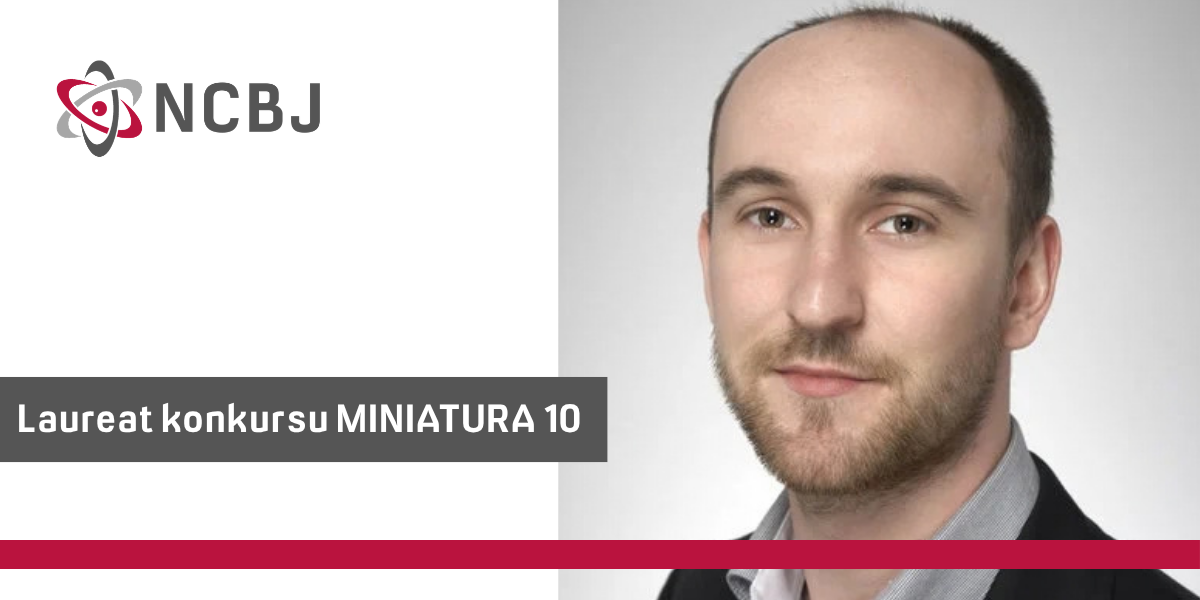
The National Science Centre has announced the ranking list for the latest edition of the MINIATURA 10 competition. Among the winners was a project by dr inż. Wojciech Kubiński, from the NCBJ’s Reactor Research Division, entitled “Assessment of the physical consistency of artificial intelligence models in nuclear sciences based on OECD NEA benchmark data”.
The MINIATURA call for proposals concerns preliminary research, literature reviews or academic visits that will form the basis for future applications for research project funding. It is aimed at individuals who have at least one academic publication or artistic achievement to their name and who have been awarded a PhD.
The latest ranking list, published at the end of September by the National Science Centre, included 158 research projects. Among the projects that received funding was a project by a researcher from the National Centre for Nuclear Research entitled “Assessment of the physical consistency of artificial intelligence models in nuclear sciences based on OECD NEA benchmark data”.
"The idea behind this project stems from the increasingly widespread use of artificial intelligence to model complex physical processes. However, as these methods develop, it is becoming increasingly important not only to achieve high prediction accuracy, but also to understand when and how incorporating physics knowledge into a model can actually improve its performance. This is particularly important in nuclear science and technology, where a model should also be assessed in terms of the uncertainty and stability of the results obtained, the ability to trace the basis on which a given prediction was made, as well as its behaviour outside the scope of the training data and its consistency with known physics principles" – explains dr inż. Wojciech Kubiński, the grant recipient.
The project will primarily focus on developing methods for conducting such an assessment. The research will encompass the selection of appropriately representative benchmark data and physics principles, the development of methods and metrics to evaluate model behaviour, and a comparison of various AI architectures supporting this approach. This will make it possible to investigate whether, and under what conditions, a genuine advantage over standard models can be achieved, both in terms of prediction quality and uncertainty assessment, as well as consistency with the laws of physics and the ability to generalise.
A significant part of the project will involve collaboration with the OECD Nuclear Energy Agency, one of the world’s leading centres for the collection, evaluation and development of nuclear data and benchmarks. Access to high-quality benchmark data, the methodologies used to evaluate them, and the expertise of OECD NEA specialists will enable the development and reliable validation of the proposed methods, based on real-world problems from various fields of nuclear science.
Congratulations and we wish you every success in your research!