English
 Polish
Workshop on detection and dosimetry techniques
06-02-2026
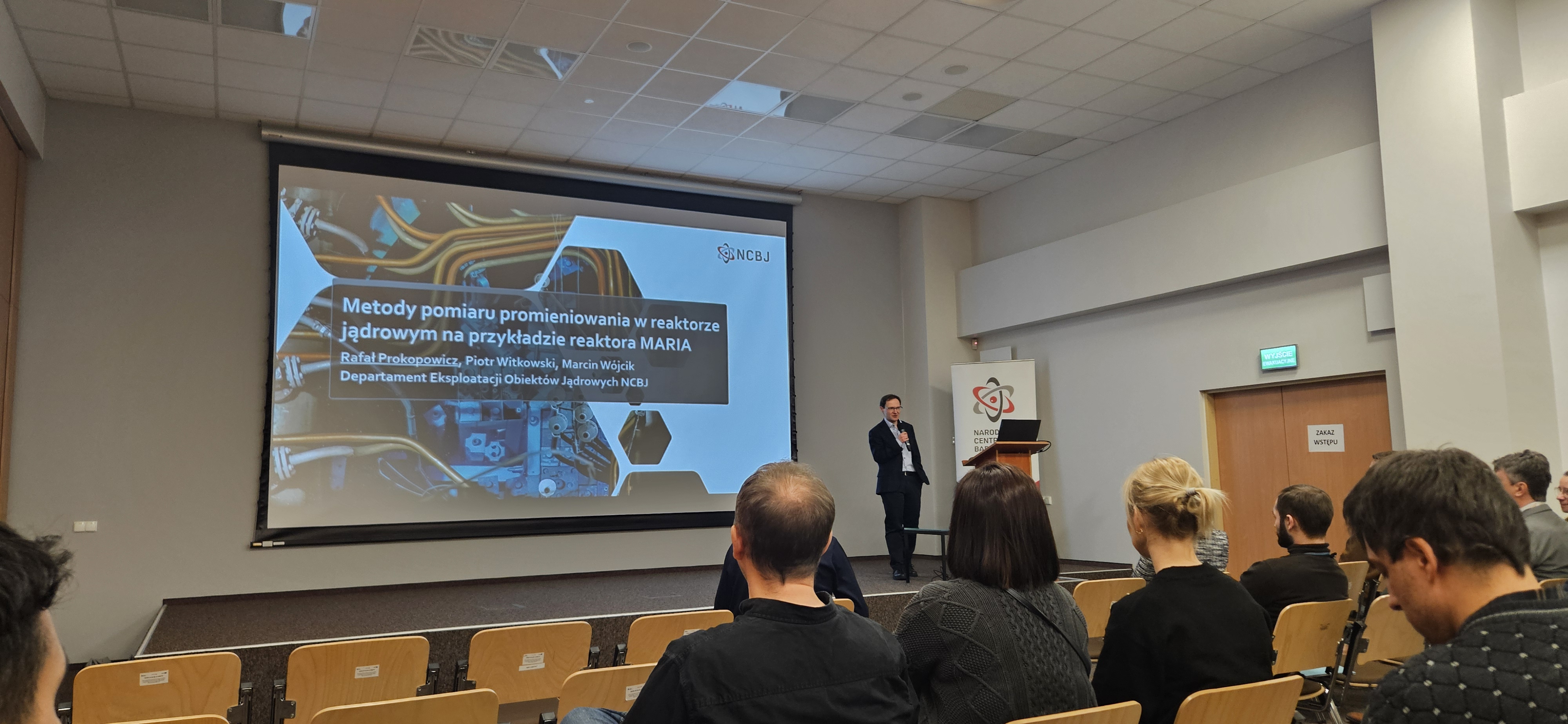
On 5 February, the Radiation Detectors and Plasma Diagnostics Division at the National Centre for Nuclear Research organised a workshop on mixed radiation detection and dosimetry. Detection techniques are used in medicine, industry and nuclear energy, among other fields.
The detection and dosimetry of mixed radiation – gamma, alpha, beta and neutron – were the subject of workshops organised by the Radiation Detectors and Plasma Diagnostics Division at the National Centre for Nuclear Research (NCBJ). During the meeting, radiation detection and dosimetry techniques were presented, along with their application in the field of nuclear energy, where radiation monitoring is a key element of the equipment at a nuclear power plant.
“In the current situation, dosimetry is particularly important. I am glad that we can start the first meeting of a new series of workshops dedicated to both specialists and students of universities and technical colleges interested in the subject of dosimetry,” said Prof. Agnieszka Pollo, Deputy Director for Science at NCBJ, during the inauguration of the meeting.
"We see the need to organise meetings not only for specialists involved in detection and dosimetry, but also for industry representatives. I hope that such meetings will result in closer cooperation between the national research community and will allow for the development and testing of systems that record and simultaneously determine the dose of various types of radiation," added Dr Agnieszka Syntfeld-Każuch from the Radiation Detectors and Plasma Diagnostics Division at NCBJ.
Ionising radiation, such as alpha particles, beta particles, gamma rays and neutrons, is used in many areas of human activity, from scientific research and industry to nuclear medicine and national security. Alpha particles are the nuclei of helium atoms, while beta particles are electrons or their positively charged counterparts, positrons. Gamma radiation is a type of electromagnetic radiation – it has no mass or charge and is produced by changes in the nuclei of atoms. Neutrons are electrically neutral particles with a mass similar to that of a proton. Unlike alpha and beta particles, they do not ionise matter directly. Alpha particles interact strongly with matter and are most often produced during the decay of heavy atomic nuclei. Beta particles appear in nuclear decays where the balance between the number of neutrons and protons is disturbed. Neutrons are usually emitted by very heavy elements, such as uranium or plutonium, in processes of spontaneous or induced fission of the atomic nucleus. Nuclear radiation is often associated with negative effects on human health. That is why it is so important to detect it and simultaneously measure radiation doses, which is the task of dosimetry.
Radiation can also have positive and useful applications in many areas of life.
These include, among others:
- nuclear medicine (diagnostics and radiotherapy), which deals with the detection
and treatment of cancer. Techniques such as positron emission tomography (PET) and scintigraphy enable the imaging of internal organs and the assessment of pathological changes; - scientific and industrial research, including studies on the interaction of ionising radiation with materials, e.g. construction materials for nuclear facilities, research on radiation converters (scintillators), neutron radiography and X-ray radiography.
- national security, understood as activities related to the control of cargo
and persons at checkpoints, such as airports or border crossings; - industry, where neutron activation analysis is used to detect key elements such as copper, zinc, iron, cadmium, mercury and lead. This technique is particularly valuable due to its high sensitivity and the possibility of analysis without destroying the object under examination;
- the armed forces, where radiation is used in techniques for monitoring contamination after the use of nuclear weapons, including portable radiation monitors and dosimetry instruments, which are standard military equipment.
We often encounter mixed radiation fields, including alpha, beta, gamma and neutron radiation. In such situations, it is necessary to record each component separately and determine the intensity or dose of each type of radiation. This task is performed by techniques for detecting and distinguishing between different types of radiation.
Research work in which detection materials and techniques for distinguishing between radiation components and determining their doses are developed and tested is currently being carried out in many laboratories, including the National Centre for Nuclear Research, the Jagiellonian University and the Kazimierz Wielki University in Bydgoszcz.
In nuclear facilities, such as nuclear reactors, as well as in detection systems used at border crossings, it is necessary to detect and distinguish between gamma radiation and neutrons occurring simultaneously in the same radiation field. For this reason, many research teams are currently working on new materials and detection techniques that enable the effective differentiation of gamma radiation from fast and thermal neutrons.