English
 Polish
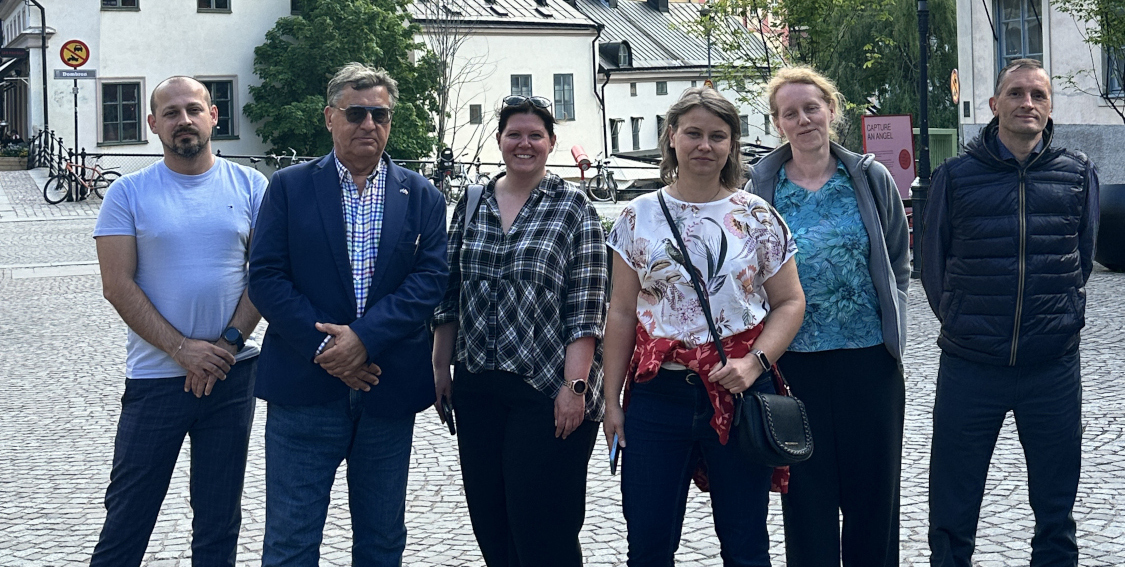
The 4NEW project delegation visits Swedish partners
12-06-2026
On 1 April 2026, the National Centre for Nuclear Research (NCBJ) officially launched the project "Plan and pilot of activities supporting the development of competencies and human resources for the nuclear sector in Poland (4NEW)", financed under the Strategic Programme of Scientific Research and Development Work "Social and economic development of Poland under conditions of globalising markets" – GOSPOSTRATEG XII competition – see https://www.ncbj.gov.pl/en/news/ncbj-becomes-partner-nationwide-program-develop-personnel-nuclear-energy-sector-start-4new.
As part of this project, a delegation from the National Centre for Nuclear Research and the project leader from the Silesian University of Technology held a series of very interesting and fruitful meetings with Swedish partners representing institutions and organisations involved in the Swedish programme to support expertise for the existing and well-functioning nuclear energy sector, as well as for the highly dynamic programme to build new reactors in Sweden. There is much to discuss with the Swedish experts – they possess a wealth of experience and expertise that will be invaluable in Poland, a country where the nuclear power sector is just emerging.
Sweden has over 70 years of experience in the development and operation of nuclear reactors using various technologies. It is a zero-emission energy sector which, for over 40 years, has covered 50% of the country’s electricity demand. By 2040, a further 10 GWel of capacity is expected to be implemented from power plants based on small modular reactors (SMRs). A preliminary selection has already been made of two reactor technologies (BWRX-300 and the Rolls-Royce 440), which are currently competing for the contract for the first 1.5 GW of capacity. Both reactor types belong to the Generation III+ and are based on light water reactor (LWR) technology.
The goal of the visit was to learn about the key aspects of education and training for the existing nuclear power sector and the planned rapid expansion of the new nuclear power sector:
- Education and training at the technical high school level,
- Education at an academic level,
- Postgraduate education,
- Education and training of reactor operators and support staff,
- Training of instructors, known as "train the trainers",
- Training of additional staff for newly built reactors.
The topic of education and training at the technical high school level was discussed during a meeting with the management and pupils of the high school in Forsmark, known as Vattenfallgymnasiet or Forsmark skolan. The school is located a few kilometres from the Forsmark power plant, which operates three large BWR reactors. During the meeting with the management and teachers, the school’s operating mechanism, cooperation with the nuclear industry and the process of developing the curriculum were presented. An overview of the educational structure and the organisation of the teaching process was also included. The school has around 100 pupils, of whom approximately 20 are studying a course directly related to the nuclear energy sector. Pupils from other schools may enroll in the fourth year of the technical programme, with around 50% of participants at this stage coming from outside the school.
During the meeting, representatives of the school agreed to provide the curriculum for analysis of its potential use and adaptation to the Polish education system, and expressed an interest in establishing cooperation with the technical high schools that will implement the 4NEW project, particularly with regard to the exchange of experiences and best practices, as well as the development of curricula for the nuclear energy sector.
It was also proposed to create an exchange programme for Swedish and Polish students. The NCBJ will pilot the cooperation between Vattenfallgymansiet and Polish schools that decide to launch a training programme for the Polish nuclear energy sector.
A meeting at the Royal Institute of Technology in Stockholm (KTH) was dedicated to the topic of education at the academic level. Prof. Sevostian Bechta outlined the history of the establishment of the Master’s programme in "Nuclear Energy" and the rapid growth of this field of study. Nuclear Energy is currently one of the most popular fields of study at KTH.
The meeting at KTH was also attended by Cilla Andersson, Director of the Swedish Centre for Nuclear Technology (SKC), an organisation that funds and coordinates research projects aimed at solving technical, engineering and scientific problems arising from the operation of Swedish nuclear reactors. SKC itself is funded by the Swedish nuclear industry and has been providing long-term support for the development of knowledge and expertise in nuclear technologies at the academic level for over 30 years. One of the outcomes of this meeting will be a proposal to establish a similar organisation in Poland.
Cooperation has also been agreed upon regarding the organisation of summer schools and courses, as well as the exchange of PhD students between the NCBJ Doctoral School and SKC.
The meeting in Uppsala with the ANItA delegation focused on postgraduate education. ANItA is a Swedish competence center (Academic-industrial Nuclear technology Initiative to Achieve a Sustainable Energy Future) specialising in Small Modular Reactors (SMRs). The discussions were attended by Sophia Grape, Director of ANItA; Håkan Gustafsson, representing the Studsvik Nuclear Technology Centre; Kyle Johnson, a representative of Westinghouse; and Elisabeth Blom, a measurement technology specialist and Board Member of Women in Nuclear.
Per Seltborg, Director of Research at Research Institutes of Sweden (RISE), presented the institute’s activities as a national research and development partner supporting innovation and collaboration between industry, the public sector and academia.
Following the discussions, it was agreed to take steps to explore opportunities for cooperation between the 4NEW project, ANItA and RISE in the areas of education, research and information exchange. Furthermore, significant similarities were noted between the mission and activities of RISE in Sweden and the Łukaszewicz Network in Poland, and steps will be taken to initiate cooperation between these organisations.
The topics of education and training for reactor operators and support staff, as well as the "train the trainers" programme, were discussed during a meeting at the KSU – Nuclear Safety and Training Centre.
KSU representatives – Maria Skogqvist and Joachim Lindström – presented a standard training pathway for reactor operators. The process of preparing an employee for the role of Field Operator takes approximately 11 months. The next stage involves training for the role of Turbine Operator, which also lasts approximately 11 months. This is followed by training for the position of nuclear power plant operator, which also lasts 11 months. The individual stages are carried out sequentially. As part of the compulsory training programme, participants also undertake a course in Radiation Protection and four additional specialist courses related to the safety and operation of nuclear facilities.
KSU has offered to collaborate with the 4NEW project and, in the longer term, to support the Polish nuclear energy programme in developing education and training programmes for reactor operators and staff, as well as training for training instructors. The topic of a Baltic hub for the supply chain, education, training and energy security of the region was also discussed.
Towards the end of their visit to Sweden, the 4NEW delegation met with Carl Berglöf, a Swedish government minister and the National Coordinator for Nuclear Energy. The Minister presented the current plans for the development of nuclear energy in Sweden and the main challenges facing the country in terms of building new generation capacity, workforce development, investment financing and ensuring energy security. Workforce development for the Swedish nuclear energy sector is the subject of the latest report prepared by Carl Berglöf for the Swedish government.
Both sides expressed their interest in exchanging experiences and information on the above topics. Another topic discussed was the Baltic supply chain hub, education, training and the region’s energy security. The Minister expressed his full support and commitment to cooperation on this matter.
The visit provided an opportunity to learn about the Swedish system of education and training for the nuclear energy sector, as well as the activities of scientific and research institutions supporting the development of this industry. Particularly valuable was the information regarding cooperation between universities, industry and research institutes, as well as details on the funding mechanisms for these activities.
The discussions held allowed for the identification of potential areas of cooperation between the 4NEW project partners and Swedish institutions such as ANItA, RISE, KTH, SKC and KSU. The experience gained and the exchange of information will provide valuable support for further activities related to the development of human resources for the Polish nuclear energy programme.