English
 Polish
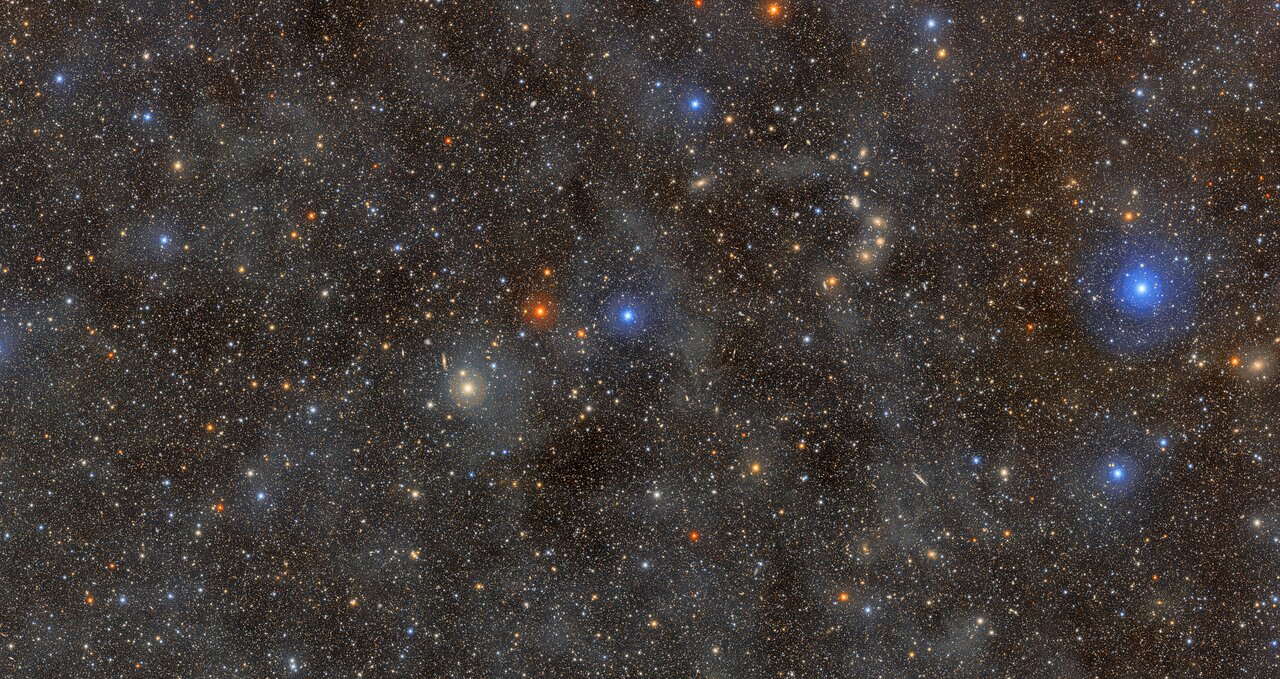
The greatest cosmic movie ever made: Vera C. Rubin Observatory starts the Legacy Survey of Space and Time
30-06-2026
A new era of astronomy and astrophysics begins, as the NSF-DOE Vera C. Rubin Observatory launches LSST, the most comprehensive cinematic record of the Universe. The initiative involves a Polish consortium composed of eight institutions, led by the National Centre for Nuclear Research.
After years of preparations by thousands of scientists from all around the world, the revolutionary survey of the southern sky has begun. Over the next decade, the observatory in Chile will record the ultra-wide, ultra-high-definition timelapse of our Universe. The project funded by the U.S. National Science Foundation and the Department of Energy will redefine modern cosmology and astrophysics. The science of the Rubin observatory is defined by the enormous effort of the instrument team and collaboration in Chile and the United States, as well as the input of a global collaboration of astrophysicists (including Polish scientists), who have participated in designing the survey and will be working with the data in the next ten years.
“It is amazing and humbling to be here at this time and place as we start the Legacy Survey of Space and Time, after more than two decades of incredible work by our dedicated team,” says Robert Blum, Director of Rubin Observatory at NSF NOIRLab.
„The decision to officially begin the LSST was made after a period of system optimization and a careful operational review of technical readiness, data system performance, and scientific validation,” says Željko Ivezić, Head of LSST. Those included image quality, survey speed, system uptime and reliability, and calibration accuracy.
Rubin Observatory’s unique design combines enormous light-collecting power with its 8.4 m mirror, the ability to move rapidly across the sky, and a wide field of view. Its 3200-megapixel camera – the largest digital camera in the world – is now capturing a new, detailed image approximately every 40 seconds. Operating with this speed and sensitivity, Rubin functions as a unified, well-tuned system capable of catching faint objects and fleeting events with remarkable reliability and consistency every night.
“It’s taken 20 years of hard science, engineering, and more to get to the point where we can call ‘action’ as we start rolling on this blockbuster movie of the Universe,” says Phil Marshall, Deputy Director of Rubin Operations for SLAC. “Millions of alerts in just the last couple of months show that Rubin is up and running as a discovery machine. Now we’re putting it all together.”
Rubin is bringing the Universe to life, illuminating a treasure trove of discoveries: pulsating stars, supernova explosions, never-before-seen galaxies, clues to the mysteries of dark energy and dark matter, and entirely new phenomena. Some cosmic processes unfold slowly, unpredictably, or incredibly rarely, which is why a ten-year survey is essential. By returning to each point in the sky about 800 times over a decade, Rubin data is providing the scientific community with deep, time-rich views needed to uncover subtle events, capture moving objects, and study the accelerating expansion of the Universe.
Not only is Rubin helping to unlock the mysteries of the distant Universe, it is also the most powerful Solar System discovery machine ever built. By taking about a thousand images every night, Rubin is compiling an astonishingly detailed census of our Solar System, including millions of asteroids and comets. In just a month and a half, during early optimization surveys, Rubin discovered over 11,000 never-before-seen asteroids, including 33 near-Earth objects and 380 trans-Neptunian objects.
Rubin will also advance opportunities for multi-messenger astronomy, which is the study of cosmic events using multiple signals such as light, gravitational waves, and cosmic rays. The observatory’s rapid, color-rich observations of transients such as stellar explosions, actively feeding black holes, and collisions between compact objects will guide telescopes around the world to follow up on these fleeting events.
Each night, Rubin is collecting approximately ten terabytes of data and producing as many as seven million alerts of changes in the night sky. These alerts stream to alert brokers – automated systems that sort and classify these changes so scientists can act quickly to follow them up with other instruments across the world and in space.
Poland had been involved in the LSST project for more than a decade, it has also been included in the Polish Roadmap for Research Infrastructures. The National Centre for Nuclear Research (NCBJ) leads the Polish LSST consortium, which currently comprises eight institutions; in addition to the NCBJ, these include: the Center for Theoretical Physics of the Polish Academy of Sciences (CFT PAN), the Nicolaus Copernicus Astronomical Center of the Polish Academy of Sciences (CAMK PAN), Adam Mickiewicz University in Poznań (UAM), Jagiellonian University (UJ), Nicolaus Copernicus University (UMK), University of Warsaw (UW), and University of Wrocław (UWr). Prof. Agnieszka Pollo, the Deputy Director for Science at NCBJ, serves as the coordinator of the Polish consortium.
The Polish consortium’s in-kind contribution to the LSST project consists of an Independent Data Access Center (IDAC) currently being assembled in Poland, and software that will be used to analyze the data. “Given the sheer volume of LSST data, analyzing it will be a challenge unlike any astronomers have faced before. These are truly astronomical big data that will require modern automated analysis methods, including those based on machine learning and AI. Building the IDAC in Poland will help us train future professionals – some of whom will remain in academia, while others will move to outside companies,” says dr Krzysztof Nawrocki of the NCBJ, who is leading the development of the data center.
„The Polish consortium comprises more than 70 members with broad expertise spanning planetary science, astronomy, astrophysics, cosmology, computer science, data analysis, and engineering. This revolutionary venture requires multidisciplinary cooperation, and the development of new analysis methods that will handle the extraordinary amount of scientific data produced every night. Both the length and the precision of LSST observations will let us record extremely rare processes, which will lead to numerous discoveries, including such that are now impossible to predict”, says prof. Agnieszka Pollo, the head of the Polish LSST consortium.
The research interests of the members of the Polish consortium span all areas of astronomy: from small bodies in the Solar System, through the properties of stars and the Milky Way, to the studies of distant galaxies, stellar explosions, quasars, cosmology and the large-scale structure of the Universe.
The software prepared as in-kind contribution will help to estimate properties of galaxies, look for possible departures from the currently adapted standard model of the Universe, study the properties of dark energy, or determine the Hubble constant from tracing the light echo in quasars.
The unprecedented detail and depth of the LSST across the Southern sky will give scientists from nearly all areas of astronomy and astrophysics a chance to enhance their understanding of various phenomena in the universe. A topic of particular interest for NCBJ is the evolution of galaxies in the large scale structure of the Universe. The survey will capture faint objects, such as low-surface-brightness galaxies, which may account for as much as half of known galaxies in the Universe. The survey will also discover numerous Solar System objects, supernovae, as well as faint kilonova transients born from cosmic explosions.
Prof. Katarzyna Małek, Head of the Astrophysics Division at NCBJ and leader of one of the LSST in-kind projects, stressed that LSST will enable new statistical studies of the faintest and most diffuse galaxies in the Universe. “We are going to measure physical properties of ultra-diffuse galaxies, which were previously hidden from astrophysical instruments. Our multidisciplinary team will trace their evolutionary paths in dense environments in galaxy clusters, as well as in large voids in the cosmic web.”
The LSST will generate petabytes of data on both known and newly discovered astrophysical objects. The NCBJ scientific team includes experts in the fields of Solar System objects, star forming regions in our galaxy, the interstellar medium, active galactic nuclei, transients, low-surface-brightness galaxies, galaxy mergers, the cosmic web, and cosmology. Our wide range expertise will allow the Astrophysics Division to integrate all the elements to make the most of this unprecedented data stream. The team is composed of many early career researchers from around the world, including postdocs and PhD students. For these students, this will be a unique opportunity to gather expertise within a multi-national collaboration and explore the mysteries of the universe in a way that has not been possible before.
„New, unprecedented size of LSST data will allow us to discover the origins of many galaxies, understand their evolution, and interactions with the cosmic environment. It will lead to a better understanding of the history of our Universe, and may even help to explain unknown phenomena, such as the nature of dark matter and dark energy”, comments dr Anna Durkalec from the Astrophysics Division at NCBJ.
With the huge amount of data from LSST, Polish researchers will be able to find rare astronomical events. “Galaxy mergers are uncommon events in the Universe,” says NCBJ researcher dr William Pearson. “With the huge area coverage of LSST, coupled with the amazing sensitivity the telescope has, we will find orders of magnitude more galaxy mergers than any other survey.” With this, astronomers are hoping that galaxy mergers’ role in the history of the Universe will become “as clear as the sky above the Rubin Observatory”.
“Rubin will be a discovery machine for signatures of distant explosions in the Universe,” says NCBJ researcher dr Nandini Hazra. “We will find more supernovae in just a few years with Rubin than have ever been observed throughout history. Moreover, Rubin will be able to see elusive faint kilonova transients, which will allow us to study their connection to gravitational wave signals from mergers of compact objects like neutron stars. What was earlier a sliver of light is now a wide-open window into multi-messenger astronomy.”
The future data releases of the LSST survey will open the door for scientists and the public to make new discoveries. It will be a new way of exploring the Universe and uncovering its secrets.
Visit rubinobservatory.org to follow the status of the LSST in real time.
Research projects that will use data obtained from LSST include, among others:
- Barely visible: low surface brightness galaxies in the LSST era (MAESTRO 2023/50/A/ST9/00579 funded by National Science Centre, Poland)
- DUSTiny: dust influence on galaxy properties in new generation surveys (OPUS 2024 2024/53/B/ST9/00230 funded by National Science Centre, Poland)