English
 Polish
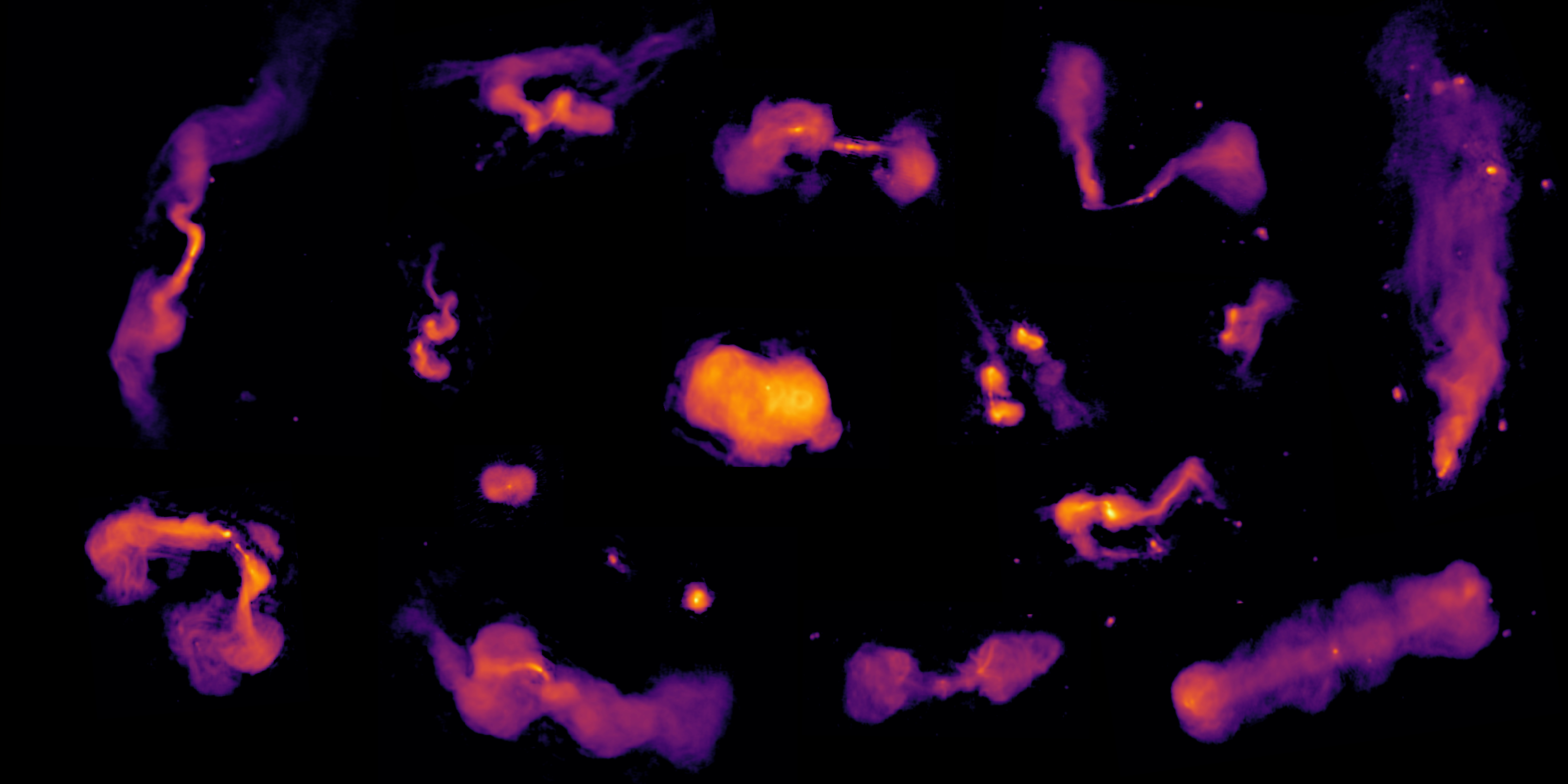
Largest Ever Radio Sky Survey Maps the Universe in Unprecedented Detail
19-02-2026
An international collaboration using the Low Frequency Array (LOFAR) has unveiled an exceptionally detailed radio sky map, revealing 13.7 million cosmic sources and delivering the most complete census yet of actively growing supermassive black holes. It showcases an extraordinary variety of systems powered by these black holes, whose radio emission can extend for millions of light-years. The newly released LOFAR Two-metre Sky Survey (LoTSS-DR3) marks a major milestone in radio astronomy and international scientific collaboration. The result is published in Astronomy & Astrophysics.
By observing the sky at low radio frequencies, the survey reveals a dramatically different view of the universe than that seen at optical wavelengths. Much of the detected emission arises from relativistic particles moving through magnetic fields, allowing astronomers to trace energetic phenomena such as powerful jets from supermassive black holes and galaxies undergoing extreme star formation across cosmic time.
Thanks to its remarkable detail, the survey has also exposed rare and elusive objects, including merging clusters of galaxies, faint supernova remnants, and flaring or interacting stars. The survey is already enabling hundreds of new studies across astronomy, offering fresh insights into the formation and evolution of cosmic structures, how particles are accelerated to extreme energies, and cosmic magnetic fields, while also making publicly available the most sensitive wide-area radio maps of the universe ever produced.
A decade of international collaboration
"This data release brings together more than a decade of observations, large-scale data processing and scientific analysis by an international research team,” says Dr. Timothy Shimwell, lead author and astronomer at ASTRON and Leiden University, Netherlands.
The achievement showcases the LOFAR European Research Infrastructure Consortium (LOFAR ERIC) model, bringing together expertise from the Netherlands, Germany, France, the United Kingdom, Poland, Italy, Sweden, Ireland, Latvia, and Bulgaria. LOFAR's unique design incorporates 38 stations in the Netherlands, and 14 international stations across Europe, with the most distant stations separated by nearly 2,000 kilometres, forming one of the world’s largest, highest-resolution and most sensitive radio telescopes.
Transformative discoveries
While the scientific exploitation is only just beginning, the scale, sensitivity and resolution of the survey are already transforming radio astronomy, enabling new discoveries across a wide range of cosmic environments.
“We can study a diverse population of supermassive black holes and their radio jets at different stages of their evolution, showing how their properties depend not only on the black hole itself, but also on the galaxy and environment in which it resides,” notes Prof. Martin Hardcastle of the University of Hertfordshire, UK. At the same time, the survey has delivered robust measurements of star formation rates in millions of galaxies, showing how these rates vary with galaxy properties and across cosmic time.
“By studying many galaxy clusters, we can show that giant shocks and turbulence drive particle acceleration and strengthen magnetic fields across millions of light-years, something we now see to be happening far more than previously anticipated,” adds Dr. Andrea Botteon of INAF in Bologna, Italy.
The data are being carefully searched for rare astrophysical phenomena, and the team have already uncovered several, including transient and variable radio sources, previously unknown supernova remnants, some of the largest and oldest known radio galaxies, and radio emission consistent with interactions between exoplanets and their host stars.
Technical innovation
Processing the data required the development of new techniques that accurately correct for severe distortions caused by the Earth’s ionosphere, the electrically charged layer of the upper atmosphere. To make the processing of 13,000 hours of observations feasible, these advances had to be combined with robust automation and optimisation.
“The software challenge was enormous,” says Dr. Cyril Tasse of the Paris Observatory, France, who led algorithm development. “It took years to design, refine and optimise the algorithms, but they now allow us to routinely produce extremely sharp and detailed images of the low-frequency radio sky, and hunt for time-variable signals from stars and exoplanets.”
Extracting the data from the telescope archives and distributing the computational workload across multiple high-performance computing systems posed an additional challenge. “The volume of data we handled - 18.6 petabytes in total - was immense and required continuous processing and monitoring over many years, using more than 20 million core hours of computing time,” says Dr. Alexander Drabent of Thuringian State Observatory, Germany.
Looking forward
With LOFAR currently undergoing an upgrade to LOFAR2.0, the collaboration plans to build upon LoTSS-DR3 and utilise the two-fold increase in survey speed offered by the upgraded instrument. Recent advances in data processing are also making it increasingly feasible to image the survey data at much higher resolution, opening the door to even more detailed studies.
“LoTSS-DR3 is not an endpoint, but a major milestone”, notes Square Kilometer Array Observatory scientist Dr. Wendy Williams. “New facilities such as LOFAR2.0 will allow us to map the radio universe with even greater sensitivity and resolution, extending the legacy of this survey well into the future.”
"With DR3, LoTSS reaches a new level of scale and sensitivity, redefining what is possible in low frequency radio astronomy. Having seen it evolve from its early stages, it is remarkable how profoundly it now shapes our understanding of AGN activity, feedback, and large scale structure, delivering breathtaking images of a Universe we have never seen in such detail and promising many new discoveries still to come", comments dr Pratik Dhabade from the Astrophysics Division at NCBJ.
Article
T.W. Shimwell, M. J. Hardcastle, C. Tasse, et al., The LOFAR Two-metre Sky Survey VII. Third Data Release, Astronomy & Astrophysics, 2026, DOI: 10.1051/0004-6361/202557749 https://doi.org/10.1051/0004-6361/202557749
arXiv: https://arxiv.org/pdf/2602.15949
About LOFAR-ERIC
The LOw Frequency ARray (LOFAR) is a revolutionary radio telescope designed and constructed by ASTRON, the Netherlands Institute for Radio Astronomy. Unlike traditional dish antennas, LOFAR consists of thousands of simple antenna elements distributed across Europe, connected by fiber optic networks. Data from all antennas are combined using powerful computers to create images of the radio sky.
LOFAR is operated by the LOFAR European Research Infrastructure Consortium (LOFAR ERIC), which brings together institutions from eight countries. LOFAR ERIC exemplifies international scientific cooperation, combining facilities, computing, and expertise across national boundaries.
The institution coordinating LOFAR research in Poland:
POLFAR – LOFAR Consortium in Poland, named after Professor Katarzyna Otmianowska-Mazur, consists of twelve scientific and research units: Jagiellonian University, University of Warmia and Mazury, Space Research Centre of the Polish Academy of Sciences, Poznań Supercomputing and Networking Centre of the Institute of Bioorganic Chemistry of the Polish Academy of Sciences, Nicolaus Copernicus University, University of Szczecin, University of Zielona Góra, Nicolaus Copernicus Astronomical Centre of the Polish Academy of Sciences, Wrocław University of Environmental and Life Sciences, National Centre for Nuclear Research, University of Wrocław, and Adam Mickiewicz University in Poznań. POLFAR is coordinated by Prof. Andrzej Krankowski from the University of Warmia and Mazury. Data from the three Polish LOFAR stations is sent to the headquarters in the Netherlands via dedicated PIONIER fibre optic cables. The Poznań Supercomputing and Networking Centre provides specialist services for the storage and processing of large amounts of LOFAR data.
About NOVA
The Netherlands Research School for Astronomy (NOVA) is the alliance of the astronomical institutes of the universities of Amsterdam, Groningen, Leiden, and Nijmegen. The mission of Top Research School NOVA is to carry out frontline astronomical research in the Netherlands, to train young astronomers at the highest international level, and to share its new discoveries with society. The NOVA laboratories are specialised in building state-of-the-art optical/infrared and submillimetre instrumentation for the largest telescopes on earth.
CONTACT INFORMATION
dr hab. Marek Jamrozy, co-author, Jagiellonian University
marek.jamrozy@uj.edu.pl
dr Timothy Shimwell, lead author, ASTRON
shimwell@astron.nl
prof. Huub Röttgering, co-author, Leiden University
rottering@strw.leidenuniv.nl