English
 Polish
Physicists from NCBJ and IAEA explain the mystery of heavy nuclei fission
04-03-2026
Physicists from the National Centre for Nuclear Research and the International Atomic Energy Agency have carried out some of the most detailed calculations on the fission of heavy atomic nuclei. The results of the research help to better understand the stability of the heaviest elements and can be used in modelling nuclear reactions. The article was published on 4 March 2026 in the journal Physical Review C.
Phys. Rev. C 113, 034305 – Published 4 March, 2026; DOI: https://doi.org/10.1103/8c6y-2jjq
Mgr Aleksander Augustyn, dr Tomasz Cap,dr Roberto Capote Noy, dr hab. Michal Kowal and prof. dr hab. Krzysztof Pomorski – authors of the publication, analysed the nuclei of actinides – from thorium to californium – focusing on the height of fission barriers, i.e. the energy barriers that a nucleus must overcome in order to split into two fragments. This parameter is crucial for the stability of heavy elements, as well as for simulating reactions occurring in nuclear reactors and astrophysical processes.
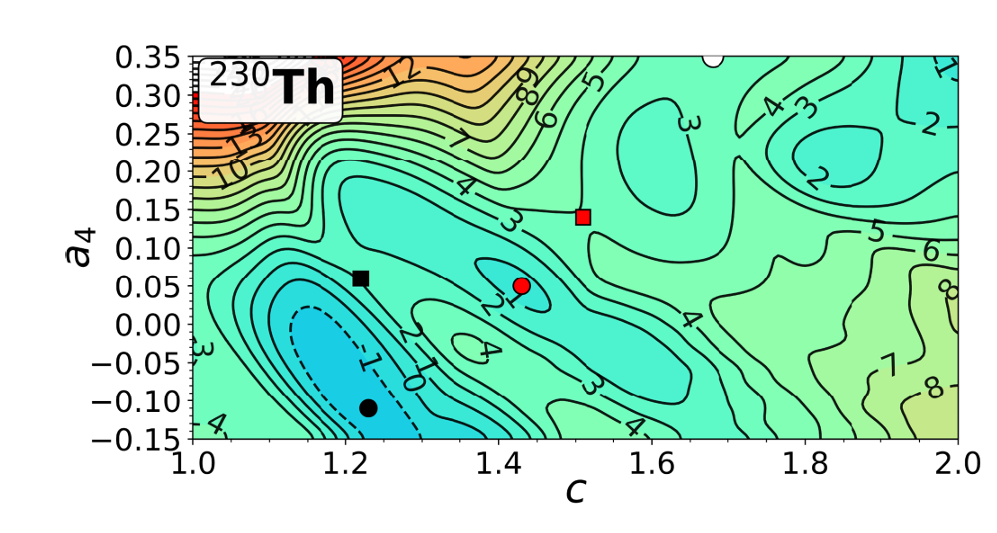
– The calculations used the Warsaw macroscopic-microscopic model developed in Poland and a five-dimensional description of nuclear deformation. We analysed approximately 130 million possible configurations of the nucleus shape for each isotope, which allowed us to very accurately recreate the so-called potential energy landscape – said A. Augustyn.
The study uses a five-dimensional parameterisation of the atomic nucleus shape, known as Fourier-over-Spheroid (FoS), which allows for a detailed description of the evolution of the nucleus shape from its ground state to the configuration just before it splits into two fragments.
– Prof. Krzysztof Pomorski, one of the authors of the paper, who co-developed this model for many years in both Warsaw and Lublin, made a significant contribution in this area. He is currently associated with the NCBJ team. The description of nucleus shapes he proposed proved particularly useful for the strongly elongated configurations encountered in the fission process – emphasises Prof. M. Kowal.
The results are in good agreement with experimental data – the differences between calculations and measurements are less than 1 MeV. The analysis also provided new information on the long-debated third energy minimum. Calculations indicate that it occurs in thorium isotopes, but not in heavier actinides such as uranium or plutonium.
– Particular emphasis was placed on the long-debated problem of the third, so-called hyperdeformed minimum in actinide nuclei. The existence of this minimum – i.e. an additional, strongly elongated nuclear configuration in which it is temporarily stable – has been the subject of scientific debate for over forty years. The results obtained in this work indicate that a shallow but distinct third minimum appears in thorium isotopes, but does not occur in heavier actinides such as uranium or plutonium – points out dr T. Cap.
The results obtained may be used in nuclear reaction databases used, among others, by the International Atomic Energy Agency, and in simulations of fission processes used in nuclear energy and astrophysics.