English
 Polish
NCBJ has developed a new method for non-destructive testing of the internal structure of complex materials
08-05-2026
A team of scientists from the National Centre for Nuclear Research has developed an innovative technique for detecting internal layers of copper in complex materials. The proposed method could revolutionise non-destructive testing in fields such as archaeometry, aerospace and electronics.
Spectroscopic methods are among the most commonly used non-destructive material testing techniques. They allow the composition of the object under examination to be determined without the need to remove a sample or damage it, which is of great importance in fields where we deal with objects of significant value, such as those of historical importance. Therefore, these methods are widely used in fields such as archeometry.
However, the methods currently available have their limitations. In the case of ancient coins consisting of a copper core coated with silver, spectroscopy is unable to penetrate deeply enough to detect the inner layers of copper. Another solution is neutron activation analysis. Although this technique allows for the analysis of the internal structure of materials, its effective use requires a neutron beam from a research reactor, which significantly limits its availability. To conduct comprehensive studies of complex multilayer materials, new non-destructive methods are needed that will allow for deeper penetration into their structure.
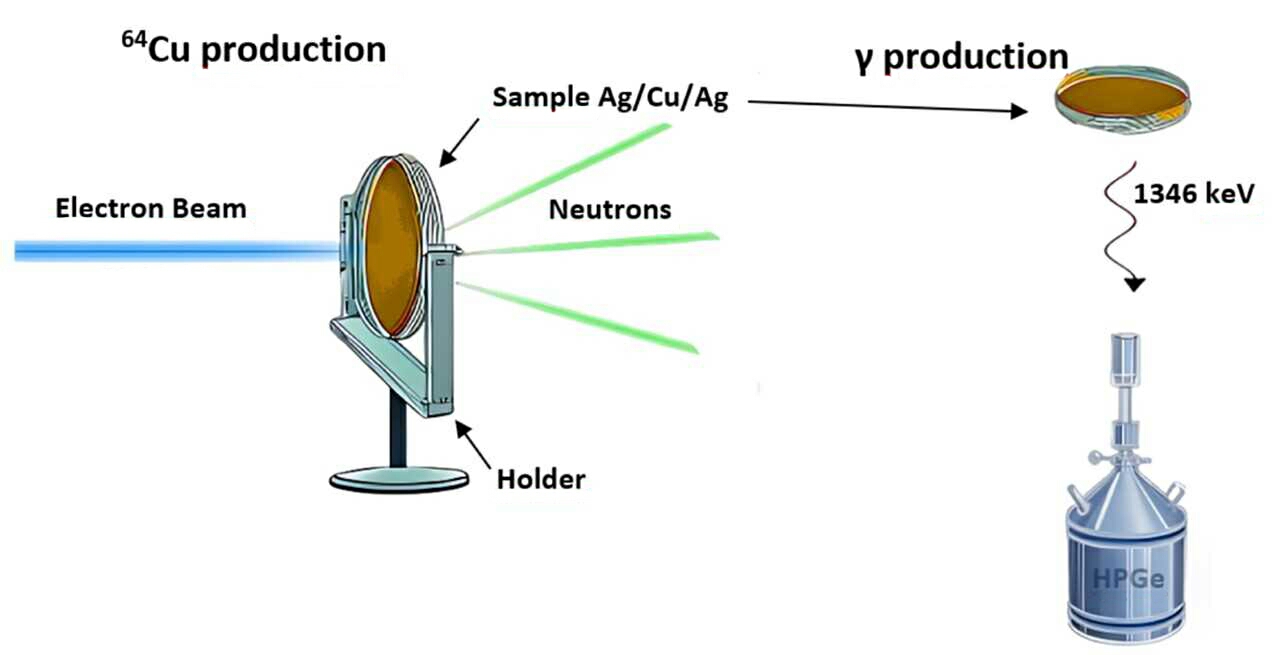
A group of scientists from the Department of Nuclear Techniques and Equipment at the National Centre for Nuclear Research (NCBJ) has taken on this challenging task. They have developed an innovative method based on the separation of neutrons under the influence of an electron beam from an accelerator. – Our proprietary COCONEC method – Composite Core-Neutron(separation)-Electron Capture – utilises electrons accelerated to an energy of 15 MeV, which generate gamma radiation triggering nuclear reactions (γ,n). As a result, copper-64 is produced in the material, which decays by emitting characteristic gamma radiation. This allows us to unambiguously detect the presence of a copper core hidden beneath layers of other metals. This is the world’s first method to combine electron-induced neutron separation with gamma spectroscopy for non-destructive testing – explains dr Aneta Gójska from the Particle Acceleration Physics and Technology Division at NCBJ, the lead author of the recently published paper.
Research has confirmed that the new method effectively detects the presence of copper in the inner layers of a material. It could revolutionise non-destructive testing by overcoming the limitations of conventional spectroscopic methods and the limited availability of neutron activation analysis. The COCONEC method allows for the examination of delicate and irregular objects, but its application is not limited to archaeometry alone. The technique could be used, for example, in the aerospace industry to assess the quality of multi-layered elements, or in electronics and materials engineering, where copper layers are used in the production of components. Researchers at the NCBJ will continue to investigate the potential applications of the new method. By optimising the parameters of the accelerator and detectors, COCONEC will find wider applications in areas where non-destructive material testing is essential.
The research results are available in the publication: A. M. Gójska, S. Wronka, K. Trela, T. Kosiński, G. Saworska, E. Miśta-Jakubowska, K. Kacperski, J. Klimaszewski, M. Matusiak, M. Staszczak, A. Wasilewski, M. Wiktorowicz, M. Wojciechowski, Ł. Kaźmierczak, COCONEC: An innovative non-destructive approach to detect composite cores and evaluate layered structures beyond conventional methods, Measurement, Volume 275, 2026, 121384, ISSN 0263-2241, https://doi.org/10.1016/j.measurement.2026.121384.