English
 Polish
New radiation detectors from NCBJ – a step towards more accurate measurements
10-04-2026
Scientists at the National Centre for Nuclear Research are developing a new type of detector capable of simultaneously detecting different types of radiation. The use of composite scintillators will enable more accurate and faster radiation measurements, which is significant in fields such as medicine and radiation protection.
Scintillation detectors are widely used in fields where the detection of ionising radiation is crucial. Their popularity comes from, amongst other things, their high detection efficiency and their suitability for real-time measurements. In practice, detectors often operate in a mixed radiation field, where α, β and γ radiation are present simultaneously. Accurate analysis of such a field therefore requires the detector to be capable of simultaneously recording and separating different types of radiation, which remains a major challenge for a single detection material.
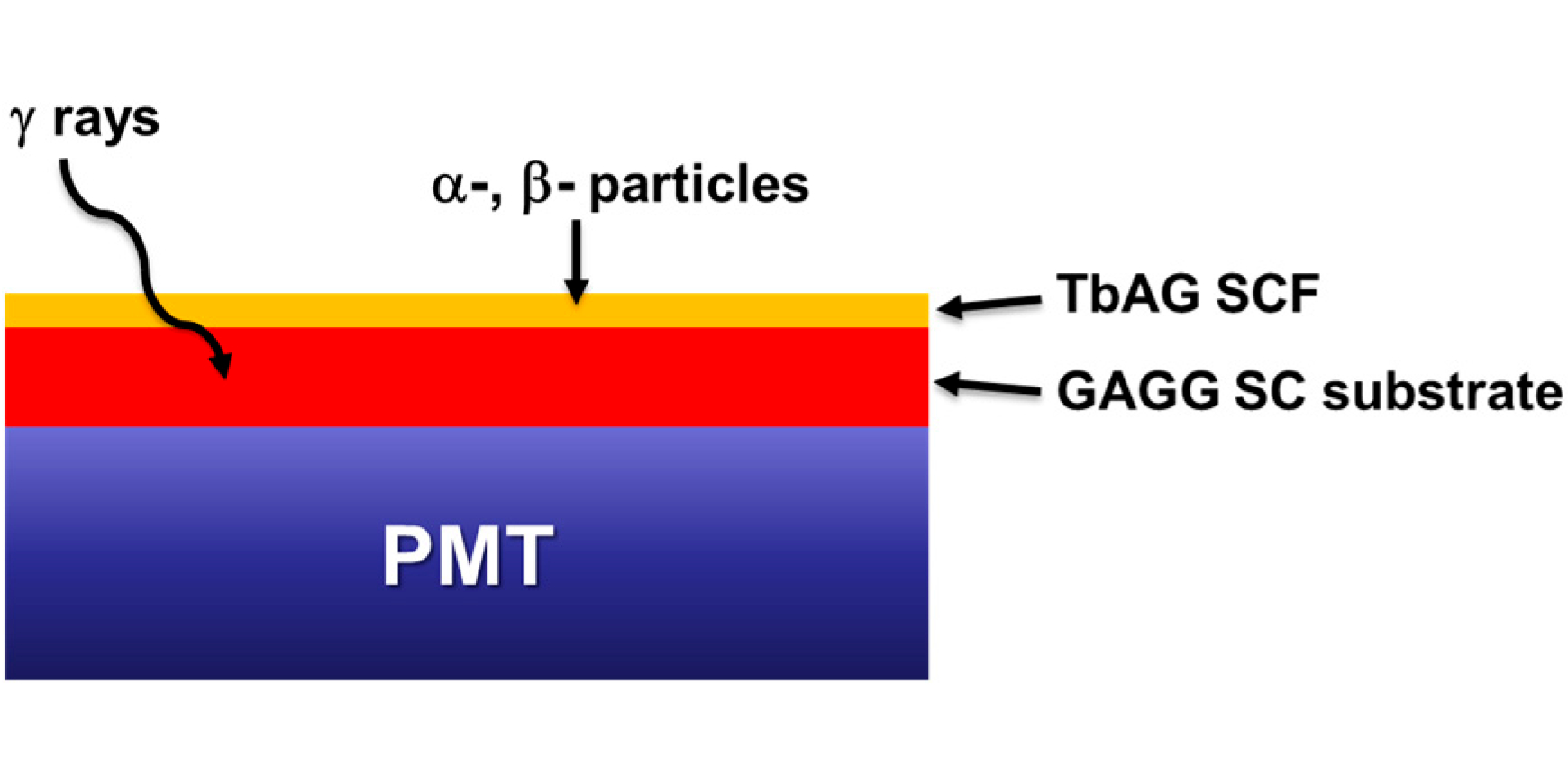
One approach that has attracted the attention of researchers worldwide is the creation of a detector composed of several scintillation layers, wherein the structures under investigation consist of a base scintillation material with a larger volume, onto which a thin layer of a different scintillator is grown. This solution allows radiation particles to be distinguished based on their range within a given scintillation layer. – Low-energy α and β particles have low penetration depth, so they are mainly stopped in the first layer of the composite scintillator. Higher-energy radiation, particularly γ-rays, penetrates further, so we detect it in the deeper layers, mainly in the base scintillator, i.e. the substrate. The layers of the composite scintillator are characterised by different time responses (different scintillation decay rates) during the conversion of energy deposited in the crystal, which is crucial for distinguishing the components of mixed radiation in terms of the shape of the light pulse – explains dr Agnieszka Syntfeld-Każuch from the Radiation Detectors and Plasma Diagnostics Division at the National Centre for Nuclear Research (NCBJ), the lead author of the new publication. These properties enable the creation of a detector that effectively distinguishes between different types of ionising radiation recorded simultaneously.
In their new study, the researchers took a closer look at composite scintillators based on a single crystal of GAGG:Ce (cerium-doped gadolinium-aluminium-gallium garnet), a substance known for its scintillation properties. A layer of TbAG (terbium-aluminium garnet), which exhibits a completely different response to radiation and was additionally doped with cerium and magnesium ions, was deposited onto the substrate using liquid-phase epitaxy (LPE). The resulting two-layer material was combined with a photomultiplier to form a mixed radiation detector.
The innovative detector was subjected to tests designed to determine its ability to distinguish between different types of radiation in a mixed field. To determine the properties of the composite scintillator, methods used included comprehensive spectrometric measurements, analysis of scintillation decay kinetics, and the PSD (pulse-shape discrimination) method. – Our work has shown that the new scintillator exhibits a different response depending on the type of radiation, so it can be an effective tool for the simultaneous detection and separation of mixed radiation. Furthermore, unlike typical stacked ‘sandwich’ scintillators (such as phoswiches) used to distinguish between α -γ or neutron-γ radiation, our composite material is ideally suited for the simultaneous detection of three types of radiation – α, β and γ – using a scintillator with an epitaxial layer architecture – says dr Abdellah Bachiri from the Radiation Detectors and Plasma Diagnostics Division at NCBJ, co-author of the study.
The next phases of the project will focus on using multilayer scintillators to determine mixed radiation doses in medical applications, including BNCT therapy. Further research into these materials is also intended to improve their luminous efficiency and assess their suitability for the simultaneous detection of various combinations of radiation at different energies. However, the potential for using new composite scintillators in radiation protection and dosimetry is already evident.
The results of research by scientists from the National Centre for Nuclear Research, Kazimierz Wielki University in Bydgoszcz and the Oncology Centre in Bydgoszcz have just been published in the scientific journal Crystals:
Syntfeld-Każuch A, Szczęśniak T, Bachiri A, Brylew K, Gorbenko VI, Zorenko T, Syrotych Y, Sidletskiy O, Zorenko Y. Characterization of Novel Composite Scintillators Based on the Epitaxial Structures of TbAG:Ce/GAGG:Ce and TbAG:Ce,Mg/GAGG:Ce Garnets in Mixed Radiation Fields. Crystals. 2026; 16(4):230. https://doi.org/10.3390/cryst16040230