English
 Polish

Polish HTGR-POLA reactor confirms a high level of safety. Research results published in Nuclear Technology.
29-01-2026
Scientists working on the HTGR-POLA project have achieved an important success on the international stage. The results of detailed safety analyses of the modern nuclear reactor have been published in the prestigious scientific journal Nuclear Technology, issued by the American Nuclear Society.
HTGR-POLA is a high-temperature nuclear reactor cooled with helium, designed as a technology demonstrator for Polish industry. Its main purpose is to supply very high-temperature heat, which can be used, among others, in the chemical and petrochemical industries and in hydrogen production. As a result, the reactor can make a tangible contribution to reducing CO₂ emissions and supporting the decarbonization of industry.
In the published article, it was shown for the first time how the HTGR-POLA reactor behaves under the most demanding accident scenarios. The computer simulations used confirmed that even in extreme conditions, the fuel temperature remains well below the safety limit. This means that the reactor relies on so-called inherent safety—based on the laws of physics rather than on complex engineered systems.
The authors of the study emphasize that the optimized reactor core design further enhances its resistance to accidents. The results obtained will serve as a basis for further analyses and for the preparation of documentation required to obtain a construction license for a nuclear facility.
The HTGR-POLA project is being implemented by the National Centre for Nuclear Research in cooperation with the Japan Atomic Energy Agency, as well as industrial partners from Poland and Japan. It may become one of the key elements of Poland’s energy and industrial transformation, while also creating an opportunity to develop domestic expertise in the field of advanced Generation IV reactors.
The full study is available in the following publication: Skrzypek, M., Skrzypek, E., & Muszyński, D. (2026). Thermal-Hydraulic and Neutronic Deterministic Safety Analysis for the HTGR SMR Research Demonstrator for Poland. Nuclear Technology, 1–11. https://doi.org/10.1080/00295450.2025.2582290 [access after logging in].
NCBJ Library: https://www.ncbj.gov.pl/en/ncbj-library.
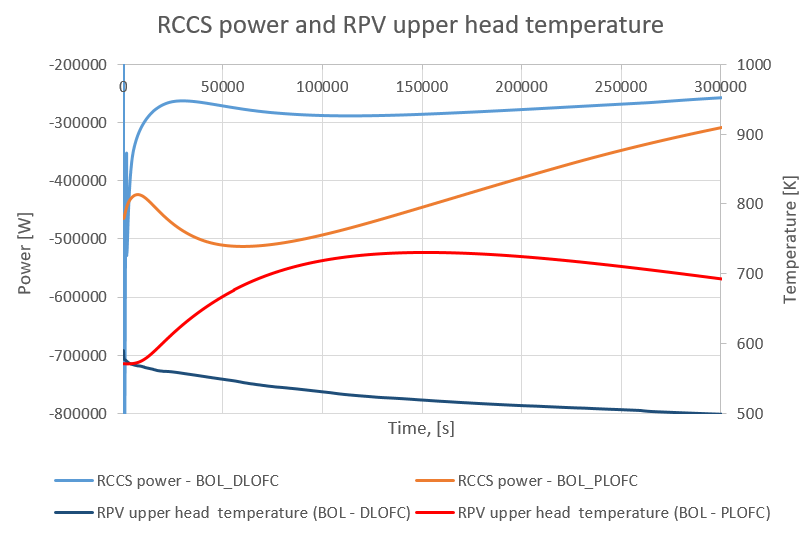
Heat removed by the RCCS and the RPV vessel head temperature for the DLOFC and PLOFC accident scenarios.
Source: Skrzypek, M., Skrzypek, E., Muszyński, D., Thermal-Hydraulic and Neutronic Deterministic Safety Analysis…, Nuclear Technology, 2026, Taylor & Francis. DOI: 10.1080/00295450.2025.2582290
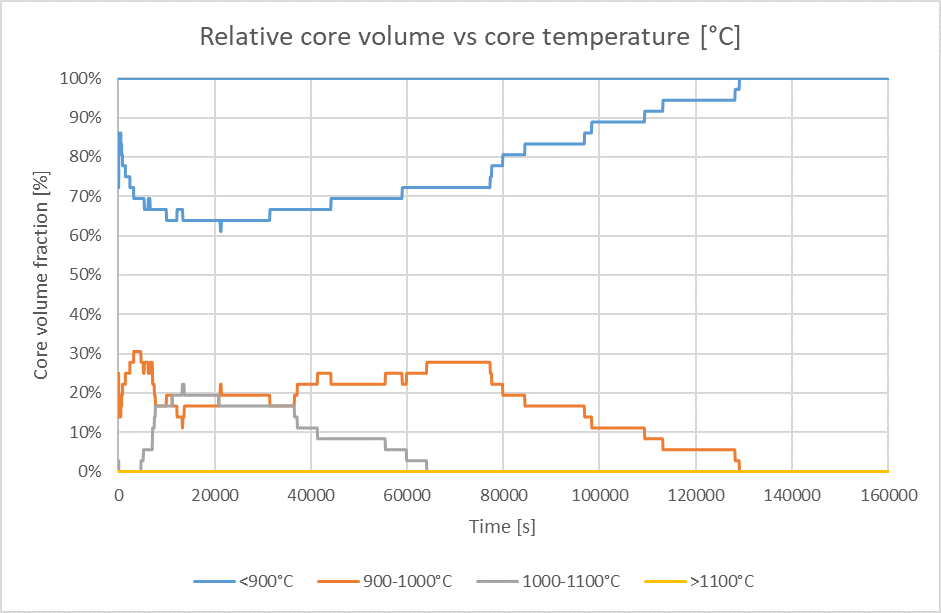
Core power fraction as a function of fuel temperature for the DLOFC scenario at BOL, optimized power profile (v2).
Source: Skrzypek, M., Skrzypek, E., Muszyński, D., Thermal-Hydraulic and Neutronic Deterministic Safety Analysis…, Nuclear Technology, 2026, Taylor & Francis. DOI: 10.1080/00295450.2025.2582290
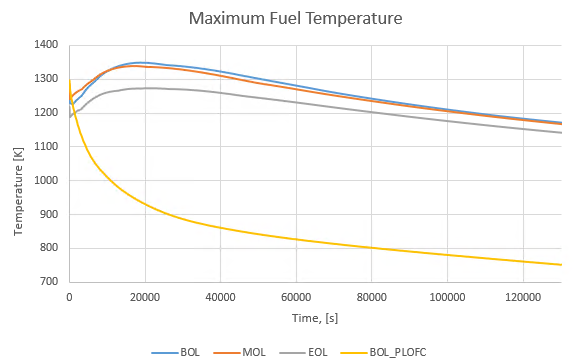
Maximum fuel temperature for the optimized core in the DLOFC and PLOFC scenarios.
Source: Skrzypek, M., Skrzypek, E., Muszyński, D., Thermal-Hydraulic and Neutronic Deterministic Safety Analysis…, Nuclear Technology, 2026, Taylor & Francis. DOI: 10.1080/00295450.2025.2582290
What do these graphs show?
The graphs illustrate how the HTGR-POLA reactor behaves under challenging accident conditions related to a loss of cooling.
The first figure shows that the passive heat removal system (RCCS) automatically takes over after a failure and effectively removes excess heat from the reactor. As a result, the reactor vessel temperature rises slowly and remains at a safe level.
The second graph shows how the fuel heats up throughout the entire reactor core. The results indicate that the vast majority of the core remains within a safe temperature range, while only a small portion temporarily reaches higher values. Importantly, temperatures do not approach levels that could threaten fuel safety.
The third figure presents the maximum fuel temperature during an accident. In each analyzed case, the temperature quickly reaches its peak and then begins to decrease. Most importantly, even in the most unfavorable scenarios, it remains well below the allowable safety limits.