English
 Polish
Super-Kamiokande reports the first indication of the Diffuse Supernova Neutrino Background
29-06-2026
The research results were presented on June 25, 2026, at Neutrino 2026: XXXII International Conference on Neutrino Physics and Astrophysics, held at the University of California, Irvine, USA.
The Super-Kamiokande Collaboration has, for the first time in the world, found an indication of the Diffuse Supernova Neutrino Background (DSNB) at a significance level of 2.6 sigma (99.5% confidence level). This result was obtained through a detailed analysis of approximately 5,000 days of observational data, combining the pure-water operation period (3,349 days between 2008 and 2020) and the gadolinium-loaded period (1,653 days from 2020 to the present).
The DSNB is the integrated flux of neutrinos originating from all core-collapse supernovae throughout cosmic history, and its direct detection has been a long-standing goal since the launch of the Super-Kamiokande (SK) project. This achievement provides an important clue for deepening our understanding of the history of cosmic star formation and nucleosynthesis.
Core-collapse supernovae are explosive phenomena that occur at the final stage of massive star evolution, releasing enormous amounts of energy in the form of neutrinos. In addition to neutrinos, these explosions disperse elements synthesized in stellar interiors into space. They are thought to be the primary sources of the carbon, oxygen, silicon, iron, and other elements that constitute our own bodies and the world around us.
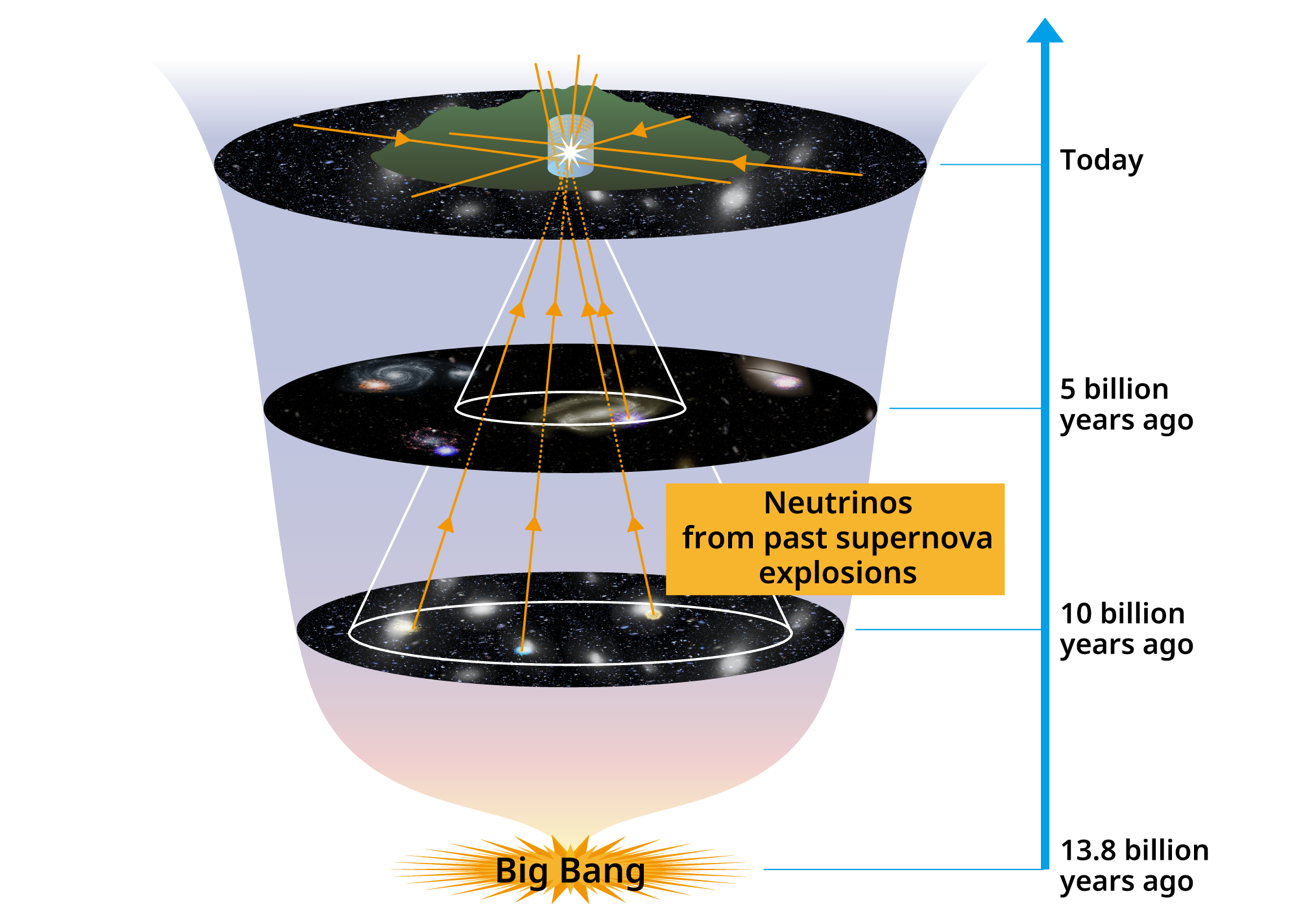
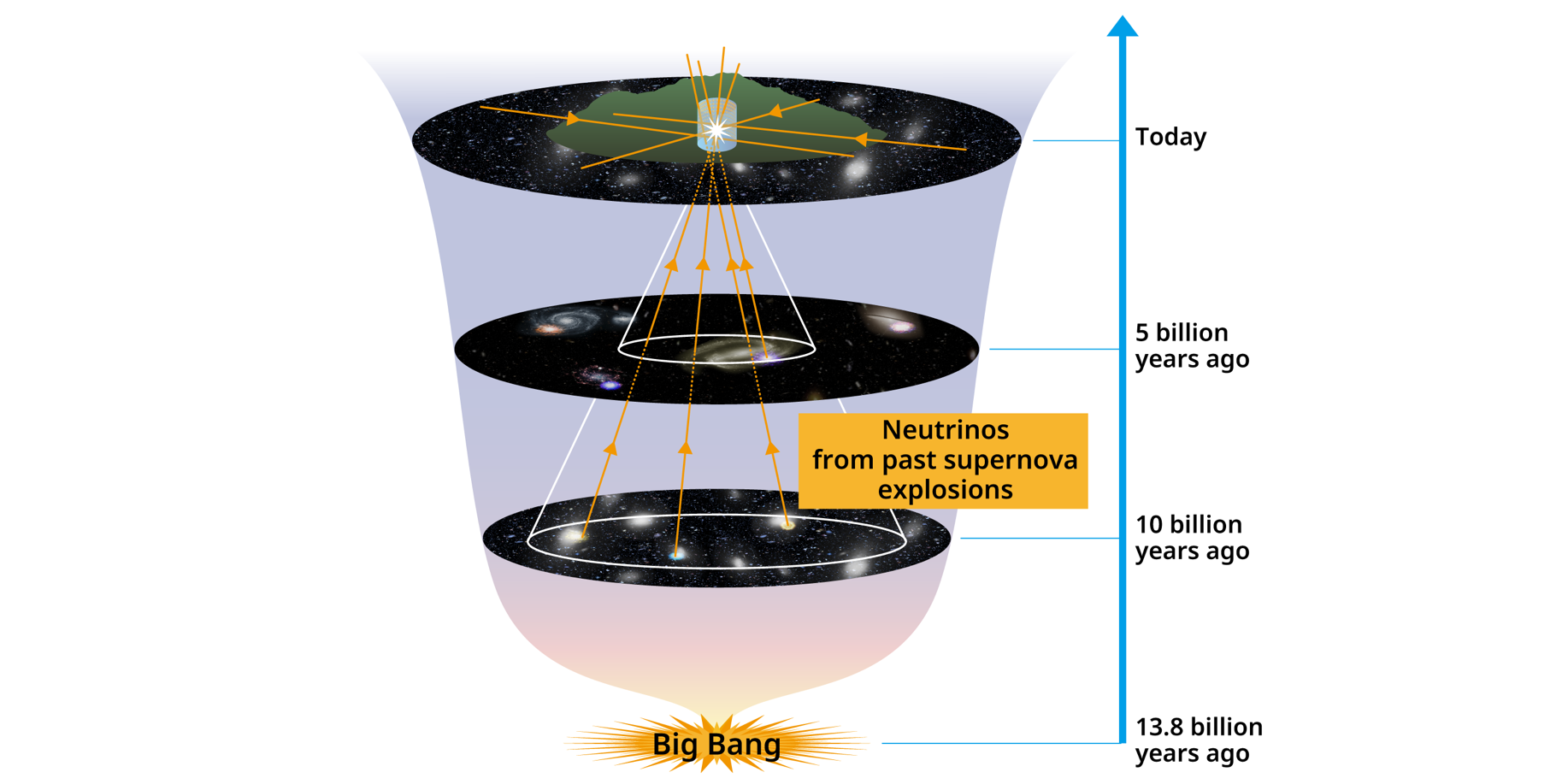
The DSNB is the accumulation of neutrinos emitted by all core-collapse supernovae throughout cosmic history, from the early universe to the present. However, neutrinos arriving from vast distances are diffuse, and their signals are extremely faint, making detection challenging.
Capturing the DSNB would provide a definitive observational means to quantitatively unravel the history of nucleosynthesis and star formation in the universe, and to test theoretical models. Undertaking this observation is nothing other than straining to hear the "faint whispers" of supernova explosions engraved in cosmic history.
SKʼs predecessor detector, Kamiokande, succeeded in the direct observation of neutrinos from a single supernova (SN 1987A). However, detecting the DSNB ̶ the accumulated signal from distant supernovae ̶ has remained a long-standing challenge for Super-Kamiokande.
Across the Universe, supernova explosions occur several times per second. Since the birth of the Universe, the neutrinos emitted by these supernovae have been travelling through space, and their number has been increasing on a cosmic timescale. This total neutrino flux is known as the Diffuse Supernova Neutrino Background (DSNB), or Supernova Relic Neutrinos (SRN).
Super-Kamiokande is the world’s largest underground neutrino observatory and began operations in April 1996. The experiment detects Cherenkov light produced when neutrinos interact with water, using a 50,000-ton tank of ultrapure water and approximately 13,000 photomultiplier tubes installed 1,000 meters underground in Kamioka, Hida City, Gifu Prefecture, Japan.
In this study, researchers analyzed approximately 5,000 days of data, combining the purewater operation period (3,349 days between 2008 and 2020) and the gadolinium-loaded period (1,653 days from 2020 to the present).
The introduction of gadolinium to SKʼs ultrapure water improved the accuracy of supernova neutrino signal identification via efficient identification of neutron captures, thereby greatly enhancing the detectorʼs background rejection capabilities.
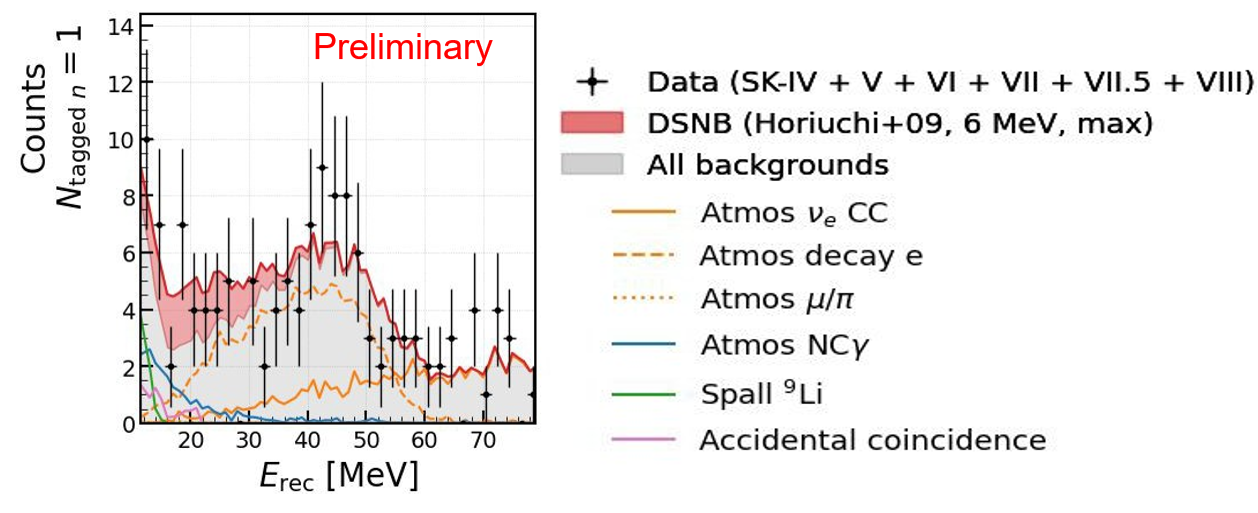
In this analysis, after effectively removing backgrounds ̶ primarily atmospheric neutrino events and spallation events involving oxygen nuclei in water induced by cosmic rays ̶ the team identified a statistically significant excess signal in the neutrino energy range from 13.3 to 81.3 MeV.
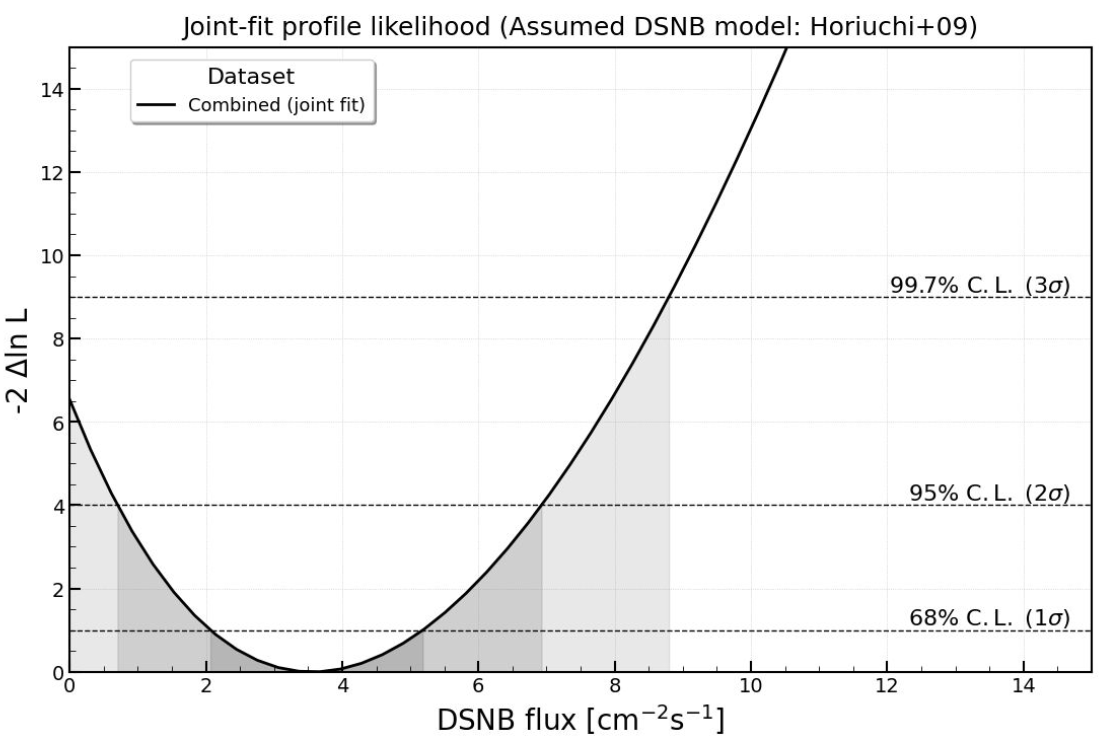
The significance of the excess signal is 2.6 sigma (99.5% confidence level). Although it cannot be explained as a random fluctuation, it does not yet meet the discovery threshold (5 sigma or higher) and is therefore currently described as an indication rather than a definitive detection. The estimated DSNB flux is 3.6 ± 1.6 cm⁻² s⁻¹, consistent with the range predicted by several theoretical models (for example, the Horiuchi et al. 2009 6 MeV model, which predicts 2.1‒3.9 cm⁻² s⁻¹).
– Observing the world's first indication of the Diffuse Supernova Neutrino Background is a deeply meaningful achievement and has been a long-cherished goal since the beginning of the Super-Kamiokande project. At the same time, the current statistical significance is 2.6 sigma, and additional data accumulation and further improvements in analysis are essential for definitive detection. We will continue observations at Super-Kamiokande and work toward a conclusive detection. We hope that this result will lead to a deeper understanding of the cosmic history of star formation and nucleosynthesis – says Hiroyuki Sekiya, Associate Professor at the Institute for Cosmic Ray Research, The University of Tokyo, and spokesperson for the Super-Kamiokande experiment.
Ongoing observations at Super-Kamiokande, together with future collaboration with its successor detector, Hyper-Kamiokande, are expected to further improve sensitivity.
This result is also expected to place strong constraints on models of cosmic star-formation rates and nucleosynthesis. In particular, it is anticipated to contribute to a better understanding of the formation processes of neutron stars and black holes, as well as the chemical evolution of the universe.
Super-K is an international collaboration involving approximately 250 researchers from 60 universities and research institutions in Japan, the United States, Korea, China, Poland, Spain, Canada, the United Kingdom, Italy, France, and Vietnam, with the Institute for Cosmic Ray Research, The University of Tokyo serving as the lead institution.
There are currently eight representatives from Poland active in Super-K, from:
- Faculty of Physics, University of Warsaw: dr Magdalena Posiadała-Zezula, dr Yashwanth S. Prabhu, dr Haradhan Adhikary, Mariusz Girguś i Prithivraj Govindaraj;
- National Centre for Nuclear Research: dr Joanna Zalipska i dr hab. Justyna Łagoda;
- University of Silesia: dr Lakshmi S. Mohan.