English
 Polish
What can particle collisions reveal? Scientists from NCBJ measure “invisible” quantum entanglement
17-04-2026
Do colliding particles remain connected in an invisible way? Scientists from the National Centre for Nuclear Research show how to measure one of the most enigmatic phenomena in physics—quantum entanglement—even when it is almost impossible to detect.
Quantum entanglement is one of the most remarkable phenomena in nature. It means that two particles can be connected in such a way that measuring one instantly tells us something about the other—even if they are separated by vast distances. It is no surprise that Albert Einstein famously referred to this as “spooky action at a distance.”
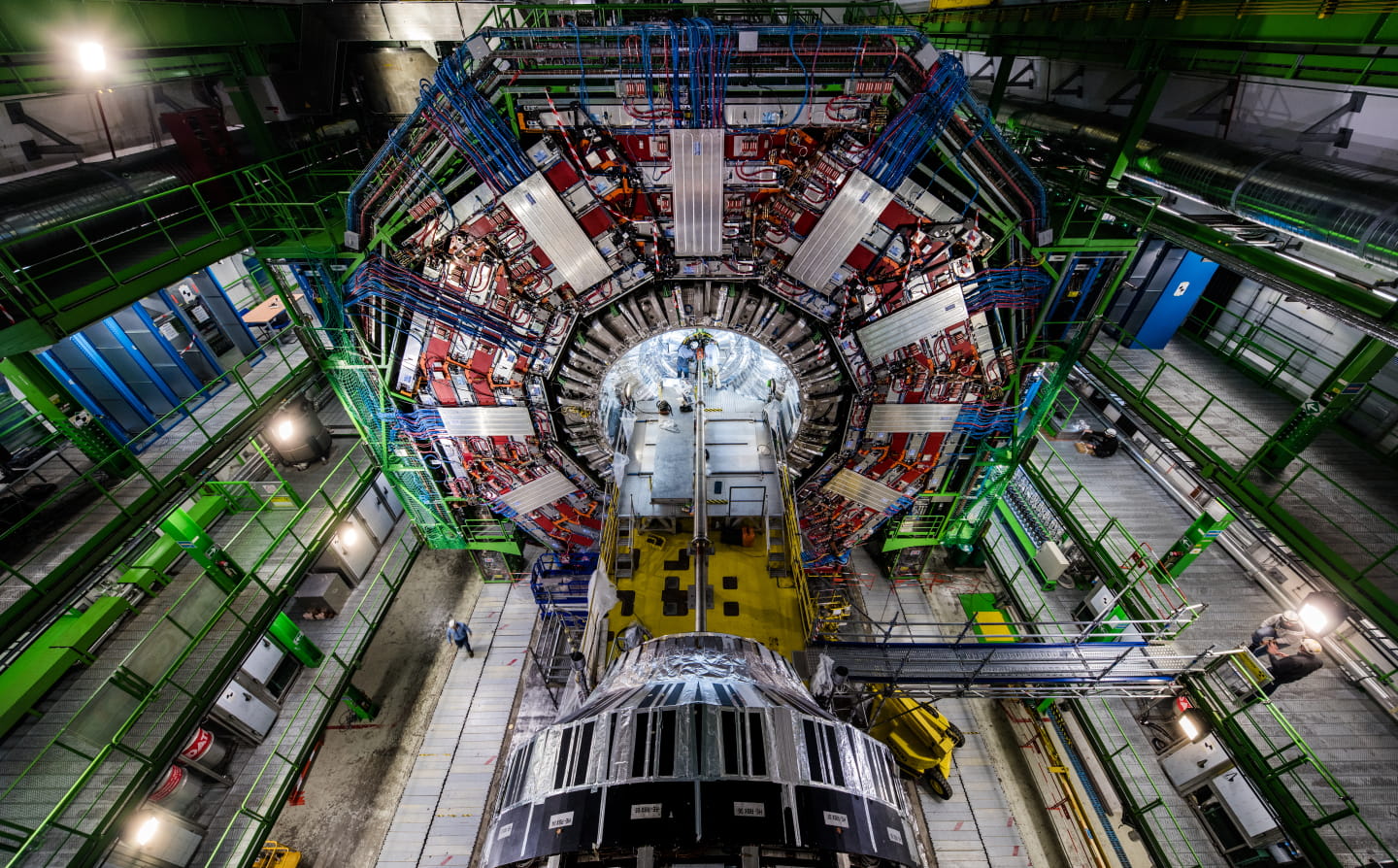
Although entanglement is a foundation of modern technologies such as quantum computing and quantum cryptography, it is still not fully understood. One of the key questions is: what happens to entanglement during particle collisions, for example in accelerators such as the Large Hadron Collider? This question was addressed by scientists from the National Centre for Nuclear Research—Prof. Kamila Kowalska and Prof. Enrico Sessolo.
How does entanglement arise in a collision?
Let us imagine two particles as coins. Before the collision, they are independent—each can land as “heads” or “tails.” However, after the collision, the situation changes: the outcome of one “coin” can immediately determine the outcome of the other. This is entanglement. In reality, the properties involved are more complex, such as spin or so-called quantum “flavour,” but the idea remains similar.
A new approach: looking broader, not more precisely
Instead of analyzing individual, specific collisions, the researchers adopted a different approach. They averaged over all possible directions in which particles can move after a collision. This allowed them to obtain an “average picture” of entanglement.
It turned out that such entanglement is typically very weak—but it does not disappear completely. The problem is that calculating it precisely is usually extremely difficult.
A simple formula for a complex phenomenon
The team’s most important achievement is the development of a simple formula that makes it possible to determine the level of entanglement without analyzing the entire complex quantum system. Instead, it is enough to calculate a single specific probability: how often particles “graze” each other during a collision and change their properties while continuing in the same direction. This greatly simplifies the work—and can save scientists a significant amount of time.
What did the examples show?
The researchers tested their method using well-known models of particle physics. The results were surprising: in some cases, entanglement arises due to a change in the “identity” of particles during the collision; in others, even though it may be locally strong, it practically disappears after averaging.
Why does it matter?
The new results connect two important areas of science: particle physics and quantum information theory. This helps us better understand how fundamental interactions generate quantum effects. In the future, this may aid in the analysis of data from particle accelerators, the discovery of new physical phenomena, and even the development of quantum technologies.
The full results of the study are available in the publication: Kowalska, K., Sessolo, E.M. Qubit entanglement from forward scattering. J. High Energ. Phys. 2026, 14 (2026). https://doi.org/10.1007/JHEP04(2026)014