English
 Polish
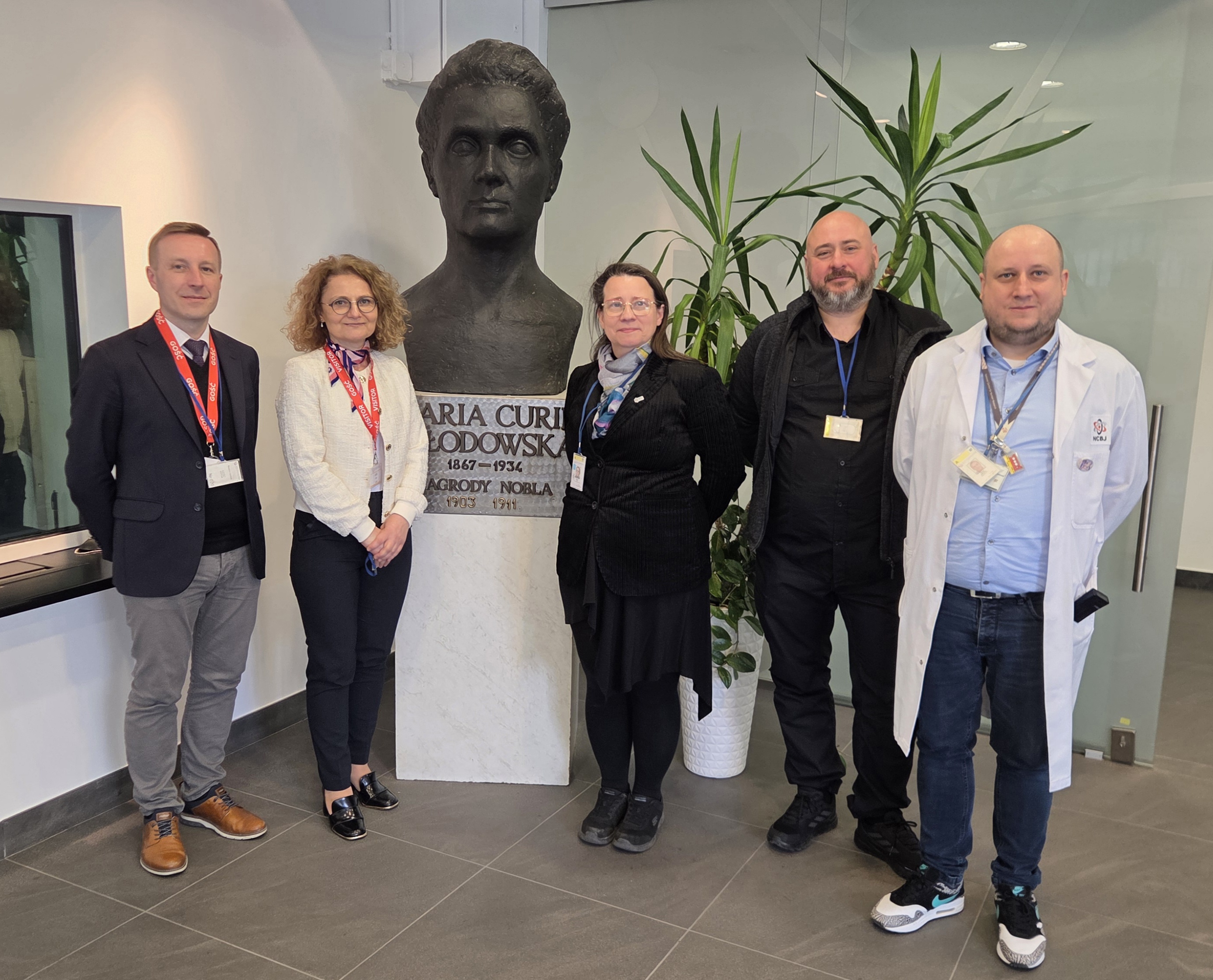
NCBJ hosted a NAHEPaM collaboration meeting
14-04-2026
The National Centre for Nuclear Research is participating in a project aimed at developing the NAHEPaM (NewAthena High Energy Particle Monitor) instrument for the European Space Agency’s NewAthena telescope. In March, the collaboration held another Progress Meeting to review the progress of the project, during which the next stages of the project’s implementation were discussed.
A hybrid meeting was attended by representatives of the National Centre for Nuclear Research (NCBJ), the Nicolaus Copernicus Astronomical Centre of the Polish Academy of Sciences (CAMK), the European Space Agency (ESA), the University of Kiel and the Italian National Institute for Astrophysics (INAF). Representatives of the Ministry of Development and Technology also took part in the organisational and financial aspects of the event – Piotr Zabadała, Deputy Director of the Department of Innovation and Space Policy and Chair of the Polish Delegation to the European Space Agency, as well as Marta Kolibabska, Head of the Space Strategy Division at the MRiT.
As part of the visit, representatives of the Ministry of Development and Technology visited the laboratories in Świerk, which are used for the development of satellite technologies. The guests also had the opportunity to visit the MARIA research reactor, one of the key research infrastructure facilities in Poland.
The meeting proceeded in a very constructive atmosphere and provided an opportunity to review the work carried out so far and to clarify plans for the coming months. Representatives of the European Space Agency, despite their very tight schedule, emphasised that they see great potential in the developing cooperation and a realistic possibility of implementing the project within the framework of the NAHEPaM collaboration.
NewAthena will be the largest X-ray space telescope ever built. The European Space Agency’s mission will enable more detailed research into the formation of structures in space, the evolution and influence of black holes on galaxies, and the most extreme cosmic phenomena. The NAHEPaM instrument will enable the measurement of the so-called X-ray background, which will help reduce statistical errors in the actual signals from astrophysical phenomena.